Jerome Shaw: Part III of Aranui 3: Cargo Cruise Ship

By Jerome Shaw: Jerome on Google+
Last week the Aranui 3 made its first landfall in the Marquesas Islands. Jerome traveled to four islands; Ua Pou, Nuku Hiva, Hiva Oa and Fatu Hiva. He completes his journey through Marquesas Island and begins the return voyage back to the Tuamotu Islands and eventually to Tahiti in the Society Islands.
Sunday in the Marquesas Islands
The boats leave early for the village of Vaitahu on Tahuata. Church begins at 8 a.m. and many on the ship want to attend. Even if your last visit to church was at the end of your parents arm attending a church service in the Marquesas is an interesting experience.
The launches bring us to the dock and it’s a short walk around the cove to the main part of the village. Music from the Catholic Church wafts out of the 150-year-old church decorated with colorful panels of stained glass lit up by the early morning sun. A block away a much smaller less ornate church also hold services. Outside this church a boy plays with a soccer ball while several girls take turns riding a bicycle. Near the Catholic Church a group of well dressed, smiling children mingle with passengers from the Aranui.
I’m glad to have this warm welcome from the residents of the Vaitahu given their ancestors first encounter with visitors to this the smallest populated island of the Marquesas. Spanish explorers landed here on Tahuata in 1595 and promptly opened fire on a crowd of the curious islanders, killing about 200. Missionaries followed on 200 years later. The generosity of the island chief confounded missionary John Harris when the chief offered his own wife to Mr. Harris for the night with the instruction that he treats her as his own wife. The missionary fled the next day.
Tahuata also is the site of the first French settlement in the Marquesas in 1842. Vaitahu has only about 200 people and entire island of Tahuata has only 650 residents. After church we have some time to walk along the beach and through the streets of the village before it is time to return to the dock for the transit back to the ship and the 2-mile sail back across the channel to Hiva Oa.
What’s on the Hanamenu?
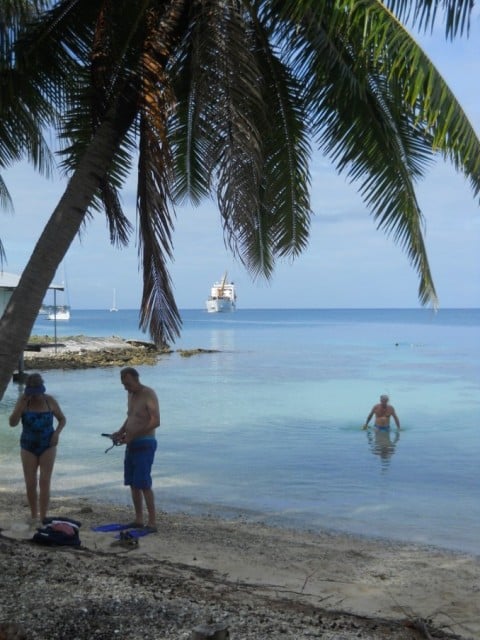
The Aranui has never visited this bay before, so even the crew is excited when we sail into the bay and drop anchor. This is a very out of the way place. I’d venture a guess that most of the 2000 people that live on Hiva Oa have never visited this secluded cove. Lunch today is going to be on the beach of a remote bay on Hiva Oa named Hanamenu. Believe me lunch is not a brown bag affair. The kitchen and dining room staff packs up everything from the ship necessary for a gourmet beach picnic.
The Aranui has never visited this bay before, so even the crew is excited when we sail into the bay and drop anchor. This is a very out of the way place. I’d venture a guess that most of the 2000 people that live on Hiva Oa have never
 visited this secluded cove. Lunch today is going to be on the beach of a remote bay on Hiva Oa named Hanamenu. Believe me lunch is not a brown bag affair. The kitchen and dining room staff packs up everything from the ship necessary for a gourmet beach picnic.
Surviving on Hiva Oa
The fourth season of “Survivor” was set on Nuka Hiva in the Taipivai Valley of Melvile fame but I can certainly see Hanamenu as a “Survivor” location. I feel like a lucky castaway today, lolling in a fresh water pool that resembles a tropical oasis, gorging myself on goat curry made by the land owner, and walking along a beach that would most certainly be deserted were it not for the hundred fifty people from the Aranui.
The fourth season of “Survivor” was set on Nuka Hiva in the Taipivai Valley of Melvile fame but I can certainly see Hanamenu as a “Survivor” location. I feel like a lucky castaway today, lolling in a fresh water pool that resembles a tropical oasis, gorging myself on goat curry made by the land owner, and walking along a beach that would most certainly be deserted were it not for the hundred fifty people from the Aranui.
After lunch there is time to swim, snorkel, paddleboard, kayak or just lounge in the sun. It is a very relaxing Sunday afternoon that ends too soon.
Back Onboard for Some Love
Before dinner we have a chance to learn a bit more about the islands we are visiting. Dr. Charlie Love is this voyage’s guest lecturer. Throughout the trip he has given us lessons on the history and archeology of the areas we have visited. He also shares a great deal of information of one of the Marquesas Islands “neighbors” Easter Island, which is his life-long passion.
Before dinner we have a chance to learn a bit more about the islands we are visiting. Dr. Charlie Love is this voyage’s guest lecturer. Throughout the trip he has given us lessons on the history and archeology of the areas we have visited. He also shares a great deal of information of one of the Marquesas Islands “neighbors” Easter Island, which is his life-long passion.
The Men Who Hunt Goats
Earlier in the cruise we have had the opportunity to see a film made by a Papeete based filmmaker Andre Vohi. Andre is traveling with his wife Ingrid and their children on this voyage to do another film about an outrigger canoe champion’s return to his home island after a 20-year absence.
Earlier in the cruise we have had the opportunity to see a film made by a Papeete based filmmaker Andre Vohi. Andre is traveling with his wife Ingrid and their children on this voyage to do another film about an outrigger canoe champion’s return to his home island after a 20-year absence.
The film about goat hunting on Ua Huka, today’s destination, is an impressive story about a family’s efforts to provide meat for an upcoming wedding celebration. As Ua Huka comes into view I can see why hunting goats on the steep slopes of this island provided such dramatic footage for the film.
The captain controls the Aranui in a poetic pirouette on anchor in a narrow passage between high rocky cliffs. The ship is then tethered with long lines that the whaleboats tow to shore and secure to the cleats that have been permanently established on the rocky shore. We are anchored at 6 a.m. and after breakfast the boats will transfer us to shore.
The Island of Goats and Ukuleles Ua Huka
It’s another caravan of SUVs that awaits us at the dock in Vaipaee. Once on shore there are meats on the grill and wares for sale. We walk a short distance up the road to a string of vehicles decorated with flowers. It is a short drive to the museum. A few passengers have signed up for horseback trip that, for the most part, parallels the route that the SUV caravan follows but takes considerably longer.
It’s another caravan of SUVs that awaits us at the dock in Vaipaee. Once on shore there are meats on the grill and wares for sale. We walk a short distance up the road to a string of vehicles decorated with flowers. It is a short drive to the museum. A few passengers have signed up for horseback trip that, for the most part, parallels the route that the SUV caravan follows but takes considerably longer.
 At the museum we are once again greeted with dancing and music but this time we are also presented with flower or stone and shell necklaces. The museum has many fine examples of Marquesan clubs, carvings, tapa cloths, sculptures, tikis, drawings and photographs. The craft center has many well-crafted ukuleles for sale along with wood carved souvenir items. One of the women now clerking in the craft shop was also a dancer during the welcoming ceremony. When the caravan packs up and I notice that the dancer/shop clerk is pulling triple duty as a driver of one of the vehicles in our caravan.
Next stop: The Botanical Garden and Arboretum for a guided tour of the grounds. Unlike most botanical gardens you are allowed to eat the fruit you find on the plants. We learn about the types of the plants we’ve seen in traveling in the islands.
After the Botanical Gardens we drive around the southern shoreline of Ua Huka. The austere rock formations help create some of the most dramatic seascapes of the trip. We see goats and wild horses along the 45-minute drive from Vaipaee to Hane. The horses were brought to Ua Huka from Chile in 1800′s and now out number the 500 island residents.
We are having lunch today in Hane at Chez Celine’s Restaurant. The tables are filled with food; some are becoming familiar, red bananas, smoked breadfruit, roast meats and fresh fruits. There are others dishes we have not seen before, especially the cakes.
Loading Copra
This afternoon we have time to explore Hane and take a short ride over the ridge to the tiny village of Hokatu where there is a small meae. The beach in Hane, with wonderful view of islet of Motuhane, is a great place for a swim. The Aranui sails into view and anchors in the bay just in front of Motuhane. The whaleboats ferry supplies for Hane and come ashore to be unloaded in the surf. Once the incoming freight is off-loaded the crew begin to load burlap sacks of copra (dried coconut) through the surf.
This afternoon we have time to explore Hane and take a short ride over the ridge to the tiny village of Hokatu where there is a small meae. The beach in Hane, with wonderful view of islet of Motuhane, is a great place for a swim. The Aranui sails into view and anchors in the bay just in front of Motuhane. The whaleboats ferry supplies for Hane and come ashore to be unloaded in the surf. Once the incoming freight is off-loaded the crew begin to load burlap sacks of copra (dried coconut) through the surf.
The whaleboats alternate between hauling loads of copra and loads of passengers back to the Aranui. Soon there is no more copra and only one load of passengers. It is time to leave Ua Huka but we do not depart alone. We are shadowed by a band of colorful outrigger canoes as we motor back to the ship. One in their group of paddlers is traveling with us on the Aranui and the rest are locals giving him a send off. As the whaleboat is lifted onto the ship the canoes peal off and paddle away.
Birds of a Feather
About 20 minutes after our departure from Hane we pass “Bird Island” on the southwest corner of Ua Huka. Thousands of seabirds swarm above the rocky cliffs of islet as the ship sails by. The calls of the birds overwhelm the sound of the ships engines. As you look more closely at the cliffs on the islands you realize that the birds still roosting on the ground dwarf number of birds in the air. We sail on towards Taiohae, on Nuka Hiva and into another remarkable sunset.
About 20 minutes after our departure from Hane we pass “Bird Island” on the southwest corner of Ua Huka. Thousands of seabirds swarm above the rocky cliffs of islet as the ship sails by. The calls of the birds overwhelm the sound of the ships engines. As you look more closely at the cliffs on the islands you realize that the birds still roosting on the ground dwarf number of birds in the air. We sail on towards Taiohae, on Nuka Hiva and into another remarkable sunset.
One Night on the Aranui
It is a special night onboard the Aranui. It’s Polynesian night. Time for a glass of rum punch around the pool and then buffet dinner on deck. Each country represented on the Aranui is supposed to put together a performance but only the Aussies and the Yanks have both talent and audacity to do so. The Polynesian dance class shows us what they’ve learned and then the crew shows us their talents. The boat is rocking late into the night with music and dancing.
It is a special night onboard the Aranui. It’s Polynesian night. Time for a glass of rum punch around the pool and then buffet dinner on deck. Each country represented on the Aranui is supposed to put together a performance but only the Aussies and the Yanks have both talent and audacity to do so. The Polynesian dance class shows us what they’ve learned and then the crew shows us their talents. The boat is rocking late into the night with music and dancing.
Returning to Melville’s Haunt Nuku Hiva
We are back in Taiohae again but just for a couple of hours. It is a last chance to buy some gifts here in the administrative capital of the Marquesas. The Aranui is at dock by 6:30 a.m. and the first trucks into the village leave at 7:45 p.m. or it is an easy walk into the village. I decide to do a bit of shopping but don’t find much I am interested in so I stop by the grocery. I purchase a liter of Coke, a pack of TimTams (Australian cookies) and a Crunchie Bar for 1085 XPF ($US11.50).
We are back in Taiohae again but just for a couple of hours. It is a last chance to buy some gifts here in the administrative capital of the Marquesas. The Aranui is at dock by 6:30 a.m. and the first trucks into the village leave at 7:45 p.m. or it is an easy walk into the village. I decide to do a bit of shopping but don’t find much I am interested in so I stop by the grocery. I purchase a liter of Coke, a pack of TimTams (Australian cookies) and a Crunchie Bar for 1085 XPF ($US11.50).
The Last Of The Marquesans Ua Pou
Lunch today is back onboard while we sail to back Ua Pou for our last stop in the Marquesas Islands. We’ve come full circle back to where our Marquesan adventure began. It is another shortstop to drop and pickup freight in Hakahau.
Lunch today is back onboard while we sail to back Ua Pou for our last stop in the Marquesas Islands. We’ve come full circle back to where our Marquesan adventure began. It is another shortstop to drop and pickup freight in Hakahau.
 We have just a couple of hours in Hakahau. Mark and Terry, a couple from Kaui that are inveterate travelers invite me to join them on hike over to the beach that I had seen on my climb up to the white cross above Hakatau during my first visit to Oa PUa. We calculate that if we hoof-it fast we’ll have time to hike over, spend an ½ hour or so on the beach and get back in time before they pull up the gangway. Xavier, a local resident that stops his well-worn four-wheel drive and invites the three of us to pile in, extends our time on the beach. He drives us to the beach, poses for photos, and then drives on. This beach is a wonderful way to spend our last minutes in the Marquesas surrounded by their isolated charm.
The Long Goodbye
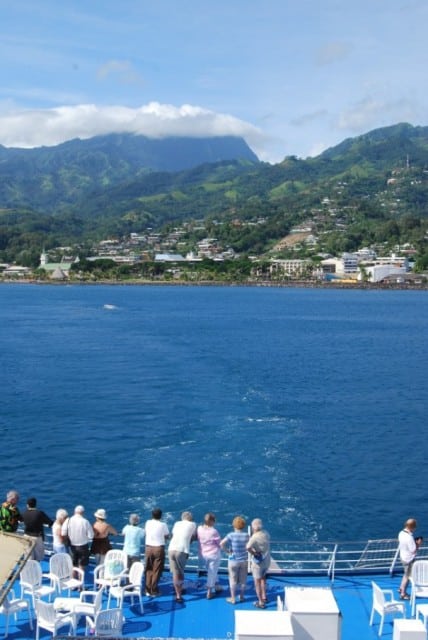
The late afternoon sun lights the peaks that resemble upturned baguettes. We sail along the coast of Ua Pou for an hour past the same dramatic cliffs and peaks we had first glimpsed just over a week ago before Ua Pou and the Marquesas Islands fade from view.
Sailing the High Seas
Another day at sea still relaxes me, but this one is a bit melancholy. We are nearing the end of our journey. Only one stop remains before our return to Papeete. We'll spend the next 40 or so hours out of sight of land as we sail from the Marquesas Islands to the Tuamotu Islands and the largest atoll in the group, Rangiroa. It is a good time to read, relax and get a head start on packing. It is also a good time spend time to spend with new friends, exchange addresses and stories.
Sighting Land in Rangiroa
It is much more difficult to spot Rangiroa than it had been to see Ua Poa. Coconut trees are by far the tallest items on this flat crescent of sand and coral that is often incorrectly listed as the second largest atoll in the world after Kwajalein Atoll in the Marshall Islands of Micronesia. Rangiroa is in the top five for size and is home to a very impressive reef that is home to wide variety of marine life.
It is much more difficult to spot Rangiroa than it had been to see Ua Poa. Coconut trees are by far the tallest items on this flat crescent of sand and coral that is often incorrectly listed as the second largest atoll in the world after Kwajalein Atoll in the Marshall Islands of Micronesia. Rangiroa is in the top five for size and is home to a very impressive reef that is home to wide variety of marine life.
One Last Hurrah!
We sail through the pass into the interior of the lagoon near some large expensive yachts and past a row of over-the-water bungalows to our anchorage. We have the day to spend on the beach or at the black pearl farm or snorkeling. You can also go for an excursion on a glass bottom boat or scuba diving on the reef. The weather is perfect. The water is bright and clear.
We sail through the pass into the interior of the lagoon near some large expensive yachts and past a row of over-the-water bungalows to our anchorage. We have the day to spend on the beach or at the black pearl farm or snorkeling. You can also go for an excursion on a glass bottom boat or scuba diving on the reef. The weather is perfect. The water is bright and clear.
A Trip Like This Can Leave Feeling a Year Older But Also Wiser
 It is my birthday and I ccan'tcan't think better place to spend it. I had hoped to do some snorkeling but could not acquire snorkeling gear from the ship. I opted for a trip to Gauguin’s Black Pearl Farm, which was much more interesting than I expected. We got to see how the oysters are seeded to create the lustrous spheres. For those looking for a last minute gift the shop at the pearl farm offer all kinds of pearl paraphernalia but also many other souvenirs.
We have one last beach feast. A half a dozen kinds of fish, various meats, salads, fruits and side dishes vie for a place on my plate. I do my best to make room for every one of them.
Tip: Bring some Pacific francs for beer or wine.
There are still a couple hours to lounge around on the beach or ignore your mother’s admonitions about swimming after lunch before the last launch departs for the Aranui.
Celebrating Our Last Night Onboard
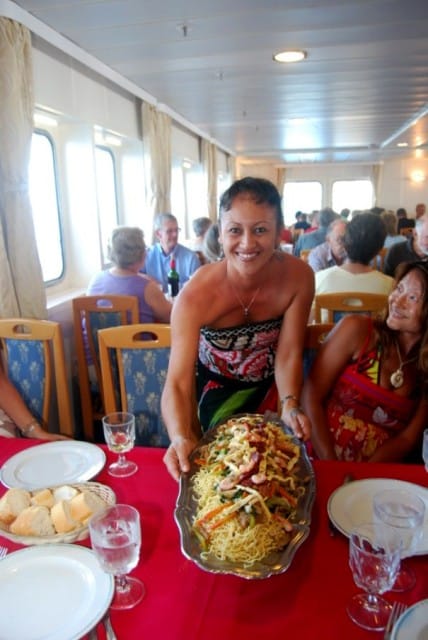
It is our last night on the ship and the last meeting of the Coconut Club, the dining group that had adopted me. Dinner is extra special tonight and starts with a huge pâté de foie gras . There are strolling musicians and lots of posing for photos with the crewmembers as everyone prepares for leaving ship in the morning. There is one last session of song and dance by the crew. And then, it is up to the bar for a last night of reverie.
It is our last night on the ship and the last meeting of the Coconut Club, the dining group that had adopted me. Dinner is extra special tonight and starts with a huge pâté de foie gras . There are strolling musicians and lots of posing for photos with the crewmembers as everyone prepares for leaving ship in the morning. There is one last session of song and dance by the crew. And then, it is up to the bar for a last night of reverie.
Departing is not so Sweet
It has been a great trip. It is always hard to say goodbye to the adventure of being on a cruise ship and all of the new friends that were made along the way. But, to quote Olivia Wilde “Even if I’m left high and dry at the end of this wild journey, just taking it is a great feeling.”
Part One French Polynesian Adventure - Freighter Cruise from Tahiti to the Marquesas Islands
Part Two French Polynesian Adventure - Freighter Cruise from Tahiti to the Marquesas Islands
Part Three French Polynesian Adventure - Freighter Cruise from Tahiti to the Marquesas Islands
It has been a great trip. It is always hard to say goodbye to the adventure of being on a cruise ship and all of the new friends that were made along the way. But, to quote Olivia Wilde “Even if I’m left high and dry at the end of this wild journey, just taking it is a great feeling.”
*The prices quote in this article are based upon the exchange rate available during the voyage aboard the Aranui 3 of 94 XPF per US$1. This rate may vary from cruise to cruise but is fixed at the beginning of each cruise for its duration. Money can be changed at the front desk from 6 to 7 p.m. each night. Guests are allowed to run a tab in the ship gift shop and the bar during the trip.
This trip was sponsored in part by the following:


Note: This trip was sponsored by Aranui 3, Fox Global Communications, Air Tahiti Nui, and Tahiti TourismTahiti Tourism.