Quantcast
Showing posts with label Marquesas Islands. Show all posts

Interview with Travel Photographer Jerome Shaw on Mode - Moderne Journal

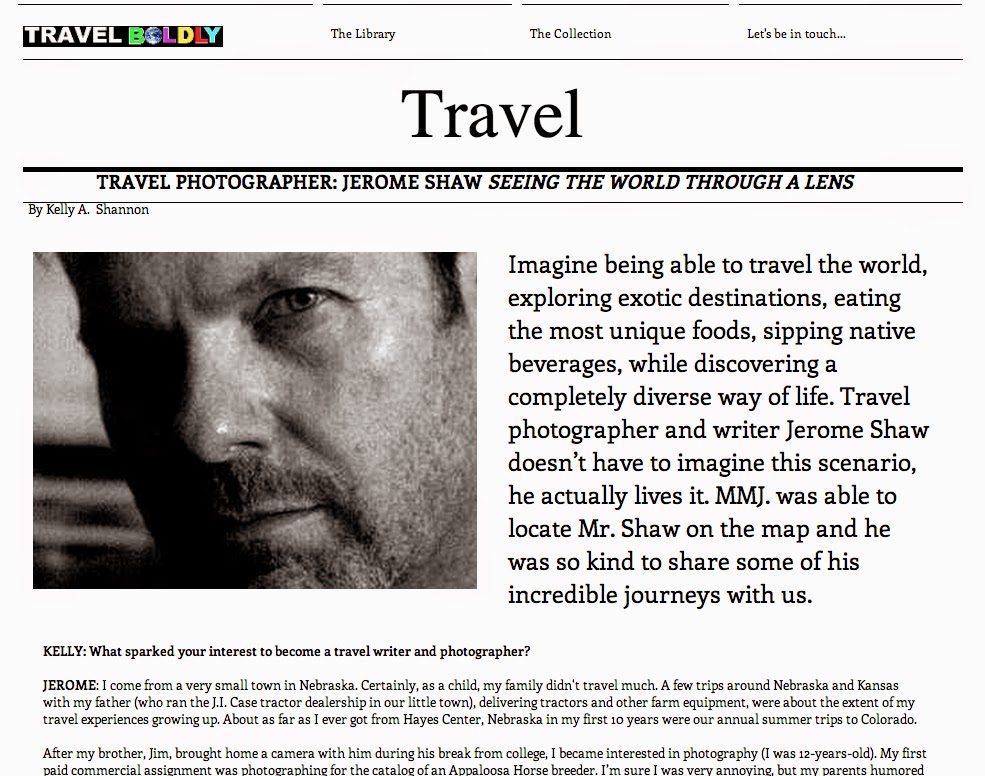
Screen capture from Mode Moderne Journal interview with Travel Writer & Photographer Jerome Shaw
Pin It


TRAVEL PHOTOGRAPHER: JEROME SHAW SEEING THE WORLD THROUGH A LENS

Imagine being able to travel the world, exploring exotic destinations, eating the most unique foods, sipping native beverages, while discovering a completely diverse way of life. Travel photographer and writer Jerome Shaw doesn’t have to imagine this scenario, he actually lives it. MMJ. was able to locate Mr. Shaw on the map and he was so kind to share some of his incredible journeys with us.

KELLY: What sparked your interest to become a travel writer and photographer?

JEROME: I come from a very small town in Nebraska. Certainly, as a child, my family didn't travel much. A few trips around Nebraska and Kansas with my father (who ran the J.I. Case tractor dealership in our little town), delivering tractors and other farm equipment, were about the extent of my travel experiences growing up. About as far as I ever got from Hayes Center, Nebraska in my first 10 years were our annual summer trips to Colorado.

After my brother, Jim, brought home a camera with him during his break from college, I became interested in photography (I was 12-years-old). My first paid commercial assignment was photographing for the catalog of an Appaloosa Horse breeder. I’m sure I was very annoying, but my parents humored me. I had a darkroom before I had car.

After studying Fine Art at the University of Nebraska, I quickly learned that my plan to become a famous “art” photographer, getting a gallery and a book deal and make millions wasn’t going to play-out. I moved to Aspen, Colorado where my brother was managing The Nugget Lodge on Main Street. I’d never been to Aspen, but I was an avid skier (well, as avid as a Nebraska Cornhusker could be). I accepted the job as assistant manager at the Nugget and was seduced by Aspen.

I wasn’t much cut out for life in the hospitality industry: making beds, cooking breakfast and doing bookkeeping is not for me. I found there was niche for a photographer somewhere between the local portrait shooter and the well-known ski photographers that were based in Aspen. I clawed my way in, went commercial, and postponed my graduate studies.

It was while I was in Aspen that my brother formed a film production company. I worked on projects with my brother and fellow photographer, Roger Morgan. Pat Griffin often joined our crew and we began making TV commercials, documentary films and eventually ski and adventure travel films.

I’d have to say that it was working on a television series sponsored by Outside Magazine for the Discovery Channel entitled “Sir Edmund Hillary’s World of Adventure” that cemented my love of travel and provided me with an opportunity to travel widely for the first time.

KELLY: When traveling, how long are you usually away from home?

JEROME: I usually have a very defined trip-length planned when I travel. And, for reasons of business and personal preference, I often keep my travels relatively short. For me, 10-14 days is best for business. However, my personal travel style is to go to a single destination and stay for month or two. I like to be in one place for as long as is practical. This way I get to know people, the pace of life and local hangouts.  But unfortunately, this method takes a toll on business and personal relationships.

KELLY: Can you tell us a few of your favorite spots off the beaten path?

Screen capture from Mode Moderne Journal interview with Travel Writer & Photographer Jerome Shaw - The Cliffs of Ua Poa, Marquesas Island, South Pacific.JEROME: The Marquesas Islands in French Polynesia cast in a central role by Herman Melville in his book Typee, and it is one of my recent favorites that are off the beaten path - waaaay off the beaten path. The Marquesas Islands are 1000 miles northeast of Tahiti. The main access for this chain of islands with names like Ua Poa, Fatu Hiva and Hiva Oa is aboard the freighter Aranui 3. I took a 14-day trip onboard the Aranui a couple of years ago. It is one of the best trips I have ever been on.

KELLY: Is there a destination you would want revisit over and over?

JEROME: New Zealand is one place that I would visit over and over. I lived there for a year and did not see nearly enough of this geographically diverse and visually dense country. Also, Brazil is my current mistress, specifically Rio. If someone calls tomorrow with a trip opportunity, I’ll be on the next plane. There are so many places in Brazil that I want to experience. Russia and Ukraine are places I have visited more than once, but I haven’t been back for many years and would like to return. In the US, Alaska is a place that I could visit once a year and never tire of.

KELLY: Where have been the easiest places to write and/or photograph?

JEROME: Peru and Ukraine, because the children are beautiful and the elderly are very photogenic. Alaska, due to its immense size and the landscapes are vast and uncluttered. But Brazil, The Marquesas Islands, and Russia were some of my favorite places to photograph.

I can’t think of any particular place that is easy to write about – but places where you get totally immersed in the culture and people prove easier to write about than places you have a tepid experience with.

KELLY: The hardest?

JEROME: As far photographing people, The British Virgin Islands was the most difficult. The people there often turned away from the camera or wanted money to have their photo taken. Weather often makes a normally photogenic locale difficult. I have had that happen in many places, but the most memorable have been in the Fiji Islands and Rio de Janeiro. Days and days of rain and gloom made getting good shots of exterior locations very tricky.

Another place that proved very difficult to capture was the lighthouse in Peggy’s Cove in Nova Scotia. They rightly placed a lighthouse on this rocky outcropped. It’s foggy there often, but the best photos of the lighthouse are made when the fog lifts. It took many, many drives out to Peggy’s Cove before I finally was fortunate enough to get that quintessential photo of the lighthouse at sunset.
The most difficult places to write about are places you are indifferent to. Love or hate make for better stories than indifference.

Screen capture from Mode Moderne Journal interview with Travel Writer & Photographer Jerome Shaw - Maisa's Lips, Copacabana, Rio de Janeiro, Brazil
KELLY: What’s one of your favorite streets in the world?

JEROME: I’m going to cheat a bit here. I don’t know what the street name is and suspect that it is not even one single street that winds its way up from Rio Centro to the hills of the Santa Teresa district of Rio de Janeiro. But I love this street and the homes and shops that line it.

I recommend you take the streetcar called bondinho, or the "little tram" (tram leaves from a station at Largo da Carioca) up to Santa Teresa. Part way to the top is a stop with a great little pizza cafĂ©, and near there - up some stairs - is a wonderful Book Hostel  Rua Francisco Muratori, 10 - Santa Teresa, Rio de Janeiro - RJ, 20510-180, Brazil. There are many wonderful B&Bs in Santa Teresa and some are in artist homes.

If I ever get the opportunity to live in Rio again, you’ll find me wandering the streets of Santa Teresa, whatever their names.

KELLY: I was surprised to learn you don’t spend as much time behind the camera as one would think a travel photographer would. What takes up the majority of your time?

JEROME: Marketing and getting the next job take up a lot of my time. The normal every day minutia of operating a business also devours many hours per month. I’m also a writer, so research and writing combine into one of the largest blocks of time I spend away from my cameras.

And then, there is the management of the photographs I have created. I spend as much time editing, captioning and preparing the images for publication as I do creating them. The fact that digital photography has changed the nature of travel photography won’t surprise anyone. But many people don’t realize how is has impacted the amount of hours photographers spend behind the camera. Many of the services that I once relied on a photographic lab to perform, I now can do myself on the computer. Certainly the computer consumes more of my time than it did 20 years ago.

KELLY: Where are you off to next and what do you want to accomplish in these travels?

JEROME: Next up is a trip to Nebraska to go sailing with one of my best friends. I know, ‘sailing and Nebraska’ doesn’t sound like a natural. After that, I’ll spend most of the rest of the summer in Colorado with the possible exception of a trip to Santa Fe, New Mexico. I have trips to Glenwood Springs, Boulder and Aspen on my summer itinerary.

I have a busy fall travel calendar, with the highlights being The Big Island of Hawaii, Bora Bora and the Riviera Maya in Mexico. I am also planning trips to Mesquite and Las Vegas, Nevada to cover events and Florida.

Each year I make my Travel Wish List and, amazingly, even with such far-flung, exotic destinations included, I usually manage to score an assignment or invitation to at least one a year. So far, I haven’t had a hit on any of my 2012 list, but Bora Bora will take care of that. Some of my other wishes for 2012 are Bali, Tibet, South Africa, Iceland, Italy and Argentina.

For more information visit www.jeromeshaw.com


Kelly Shannon is a native Californian & journalist who believes each of our unique lifestyles creates our very own way of life; from our preferences of art & literature to fashion & music. Deeply intrigued by the creators and innovators of trends, style, and vitality, she is also the Editor in Chief of MMJ.

French Polynesian Adventure - Freighter Cruise from Tahiti to the Marquesas Islands - part three


Jerome Shaw: Part III of Aranui 3: Cargo Cruise Ship

By Jerome Shaw:         Jerome on Google+
Last week the Aranui 3 made its first landfall in the Marquesas Islands. Jerome traveled to four islands; Ua Pou, Nuku Hiva, Hiva Oa and Fatu Hiva. He completes his journey through Marquesas Island and begins the return voyage back to the Tuamotu Islands and eventually to Tahiti in the Society Islands.
Sunday in the Marquesas Islands
The boats leave early for the village of Vaitahu on Tahuata. Church begins at 8 a.m. and many on the ship want to attend. Even if your last visit to church was at the end of your parents arm attending a church service in the Marquesas is an interesting experience.
The launches bring us to the dock and it’s a short walk around the cove to the main part of the village. Music from the Catholic Church wafts out of the 150-year-old church decorated with colorful panels of stained glass lit up by the early morning sun. A block away a much smaller less ornate church also hold services. Outside this church a boy plays with a soccer ball while several girls take turns riding a bicycle. Near the Catholic Church a group of well dressed, smiling children mingle with passengers from the Aranui.
I’m glad to have this warm welcome from the residents of the Vaitahu given their ancestors first encounter with visitors to this the smallest populated island of the Marquesas. Spanish explorers landed here on Tahuata in 1595 and promptly opened fire on a crowd of the curious islanders, killing about 200. Missionaries followed on 200 years later. The generosity of the island chief confounded missionary John Harris when the chief offered his own wife to Mr. Harris for the night with the instruction that he treats her as his own wife. The missionary fled the next day.
Tahuata also is the site of the first French settlement in the Marquesas in 1842. Vaitahu has only about 200 people and entire island of Tahuata has only 650 residents. After church we have some time to walk along the beach and through the streets of the village before it is time to return to the dock for the transit back to the ship and the 2-mile sail back across the channel to Hiva Oa.


What’s on the Hanamenu?
The Aranui has never visited this bay before, so even the crew is excited when we sail into the bay and drop anchor. This is a very out of the way place. I’d venture a guess that most of the 2000 people that live on Hiva Oa have never visited this secluded cove. Lunch today is going to be on the beach of a remote bay on Hiva Oa named Hanamenu. Believe me lunch is not a brown bag affair. The kitchen and dining room staff packs up everything from the ship necessary for a gourmet beach picnic.
Surviving on Hiva Oa
The fourth season of “Survivor” was set on Nuka Hiva in the Taipivai Valley of Melvile fame but I can certainly see Hanamenu as a “Survivor” location. I feel like a lucky castaway today, lolling in a fresh water pool that resembles a tropical oasis, gorging myself on goat curry made by the land owner, and walking along a beach that would most certainly be deserted were it not for the hundred fifty people from the Aranui.
After lunch there is time to swim, snorkel, paddleboard, kayak or just lounge in the sun. It is a very relaxing Sunday afternoon that ends too soon.
Back Onboard for Some Love
Before dinner we have a chance to learn a bit more about the islands we are visiting. Dr. Charlie Love is this voyage’s guest lecturer. Throughout the trip he has given us lessons on the history and archeology of the areas we have visited. He also shares a great deal of information of one of the Marquesas Islands “neighbors” Easter Island, which is his life-long passion.
The Men Who Hunt Goats
Earlier in the cruise we have had the opportunity to see a film made by a Papeete based filmmaker Andre Vohi. Andre is traveling with his wife Ingrid and their children on this voyage to do another film about an outrigger canoe champion’s return to his home island after a 20-year absence.
The film about goat hunting on Ua Huka, today’s destination, is an impressive story about a family’s efforts to provide meat for an upcoming wedding celebration. As Ua Huka comes into view I can see why hunting goats on the steep slopes of this island provided such dramatic footage for the film.
The captain controls the Aranui in a poetic pirouette on anchor in a narrow passage between high rocky cliffs. The ship is then tethered with long lines that the whaleboats tow to shore and secure to the cleats that have been permanently established on the rocky shore. We are anchored at 6 a.m. and after breakfast the boats will transfer us to shore.
The Island of Goats and Ukuleles Ua Huka
It’s another caravan of SUVs that awaits us at the dock in Vaipaee. Once on shore there are meats on the grill and wares for sale. We walk a short distance up the road to a string of vehicles decorated with flowers. It is a short drive to the museum. A few passengers have signed up for horseback trip that, for the most part, parallels the route that the SUV caravan follows but takes considerably longer.
At the museum we are once again greeted with dancing and music but this time we are also presented with flower or stone and shell necklaces. The museum has many fine examples of Marquesan clubs, carvings, tapa cloths, sculptures, tikis, drawings and photographs. The craft center has many well-crafted ukuleles for sale along with wood carved souvenir items. One of the women now clerking in the craft shop was also a dancer during the welcoming ceremony. When the caravan packs up and I notice that the dancer/shop clerk is pulling triple duty as a driver of one of the vehicles in our caravan.
Next stop: The Botanical Garden and Arboretum for a guided tour of the grounds. Unlike most botanical gardens you are allowed to eat the fruit you find on the plants. We learn about the types of the plants we’ve seen in traveling in the islands.
After the Botanical Gardens we drive around the southern shoreline of Ua Huka. The austere rock formations help create some of the most dramatic seascapes of the trip. We see goats and wild horses along the 45-minute drive from Vaipaee to Hane. The horses were brought to Ua Huka from Chile in 1800′s and now out number the 500 island residents.
We are having lunch today in Hane at Chez Celine’s Restaurant. The tables are filled with food; some are becoming familiar, red bananas, smoked breadfruit, roast meats and fresh fruits. There are others dishes we have not seen before, especially the cakes.
Loading Copra
This afternoon we have time to explore Hane and take a short ride over the ridge to the tiny village of Hokatu where there is a small meae. The beach in Hane, with wonderful view of islet of Motuhane, is a great place for a swim. The Aranui sails into view and anchors in the bay just in front of Motuhane. The whaleboats ferry supplies for Hane and come ashore to be unloaded in the surf. Once the incoming freight is off-loaded the crew begin to load burlap sacks of copra (dried coconut) through the surf.
The whaleboats alternate between hauling loads of copra and loads of passengers back to the Aranui. Soon there is no more copra and only one load of passengers. It is time to leave Ua Huka but we do not depart alone. We are shadowed by a band of colorful outrigger canoes as we motor back to the ship. One in their group of paddlers is traveling with us on the Aranui and the rest are locals giving him a send off. As the whaleboat is lifted onto the ship the canoes peal off and paddle away.
Birds of a Feather
About 20 minutes after our departure from Hane we pass “Bird Island” on the southwest corner of Ua Huka. Thousands of seabirds swarm above the rocky cliffs of islet as the ship sails by. The calls of the birds overwhelm the sound of the ships engines. As you look more closely at the cliffs on the islands you realize that the birds still roosting on the ground dwarf number of birds in the air. We sail on towards Taiohae, on Nuka Hiva and into another remarkable sunset.
One Night on the Aranui
It is a special night onboard the Aranui. It’s Polynesian night. Time for a glass of rum punch around the pool and then buffet dinner on deck. Each country represented on the Aranui is supposed to put together a performance but only the Aussies and the Yanks have both talent and audacity to do so. The Polynesian dance class shows us what they’ve learned and then the crew shows us their talents. The boat is rocking late into the night with music and dancing.
Returning to Melville’s Haunt Nuku Hiva
We are back in Taiohae again but just for a couple of hours. It is a last chance to buy some gifts here in the administrative capital of the Marquesas. The Aranui is at dock by 6:30 a.m. and the first trucks into the village leave at 7:45 p.m. or it is an easy walk into the village. I decide to do a bit of shopping but don’t find much I am interested in so I stop by the grocery. I purchase a liter of Coke, a pack of TimTams (Australian cookies) and a Crunchie Bar for 1085 XPF ($US11.50).
The Last Of The Marquesans Ua Pou
Lunch today is back onboard while we sail to back Ua Pou for our last stop in the Marquesas Islands. We’ve come full circle back to where our Marquesan adventure began. It is another shortstop to drop and pickup freight in Hakahau.
We have just a couple of hours in Hakahau. Mark and Terry, a couple from Kaui that are inveterate travelers invite me to join them on hike over to the beach  that I had seen on my climb up to the white cross above Hakatau during my first visit to Oa PUa. We calculate that if we hoof-it fast we’ll have time to hike over, spend an ½ hour or so on the beach and get back in time before they pull up the gangway. Xavier, a local resident that stops his well-worn four-wheel drive and invites the three of us to pile in, extends our time on the beach. He drives us to the beach, poses for photos, and then drives on. This beach is a wonderful way to spend our last minutes in the Marquesas surrounded by their isolated charm.
The Long Goodbye
The late afternoon sun lights the peaks that resemble upturned baguettes. We sail along the coast of Ua Pou for an hour past the same dramatic cliffs and peaks we had first glimpsed just over a week ago before Ua Pou  and the Marquesas Islands fade from view.
Sailing the High Seas
Another day at sea still relaxes me, but this one is a bit melancholy. We are nearing the end of our journey. Only one stop remains before our return to Papeete. We'll spend the next 40 or so hours out of sight of land as we sail from the Marquesas Islands to the Tuamotu Islands and the largest atoll in the group, Rangiroa. It is a good time to read, relax and get a head start on packing. It is also a good time spend time to spend with new friends, exchange addresses and stories.
Sighting Land in Rangiroa
It is much more difficult to spot Rangiroa than it had been to see Ua Poa. Coconut trees are by far the tallest items on this flat crescent of sand and coral that is often incorrectly listed as the second largest atoll in the world after Kwajalein Atoll in the Marshall Islands of Micronesia. Rangiroa is in the top five for size and is home to a very impressive reef that is home to wide variety of marine life.
One Last Hurrah!
We sail through the pass into the interior of the lagoon near some large expensive yachts and past a row of over-the-water bungalows to our anchorage. We have the day to spend on the beach or at the black pearl farm or snorkeling. You can also go for an excursion on a glass bottom boat or scuba diving on the reef. The weather is perfect. The water is bright and clear.
A Trip Like This Can Leave Feeling a Year Older But Also Wiser 
It is my birthday and I ccan'tcan't think better place to spend it. I had hoped to do some snorkeling but could not acquire snorkeling gear from the ship. I opted for a trip to Gauguin’s Black Pearl Farm, which was much more interesting than I expected. We got to see how the oysters are seeded to create the lustrous spheres. For those looking for a last minute gift the shop at the pearl farm offer all kinds of pearl paraphernalia but also many other souvenirs.
We have one last beach feast. A half a dozen kinds of fish, various meats, salads, fruits and side dishes vie for a place on my plate. I do my best to make room for every one of them.
Tip: Bring some Pacific francs for beer or wine.
There are still a couple hours to lounge around on the beach or ignore your mother’s admonitions about swimming after lunch before the last launch departs for the Aranui.
Celebrating Our Last Night Onboard
It is our last night on the ship and the last meeting of the Coconut Club, the dining group that had adopted me. Dinner is extra special tonight and starts with a huge pâtĂ© de foie gras . There are strolling musicians and lots of posing for photos with the crewmembers as everyone prepares for leaving ship in the morning. There is one last session of song and dance by the crew. And then, it is up to the bar for a last night of reverie.
Departing is not so Sweet
It has been a great trip. It is always hard to say goodbye to the adventure of being on a cruise ship and all of the new friends that were made along the way. But, to quote Olivia Wilde “Even if I’m left high and dry at the end of this wild journey, just taking it is a great feeling.”

  • Part One  French Polynesian Adventure - Freighter Cruise from Tahiti to the Marquesas Islands 
  • Part Two  French Polynesian Adventure - Freighter Cruise from Tahiti to the Marquesas Islands 
  • Part Three  French Polynesian Adventure - Freighter Cruise from Tahiti to the Marquesas Islands

  •  *The prices quote in this article are based upon the exchange rate available during the voyage aboard the Aranui 3 of 94 XPF per US$1. This rate may vary from cruise to cruise but is fixed at the beginning of each cruise for its duration. Money can be changed at the front desk from 6 to 7 p.m. each night. Guests are allowed to run a tab in the ship gift shop and the bar during the trip.
    This trip was sponsored in part by the following:
    Note: This trip was sponsored by Aranui 3Fox Global CommunicationsAir Tahiti Nui, and Tahiti TourismTahiti Tourism.

    French Polynesian Adventure - Freighter Cruise from Tahiti to the Marquesas Islands - part two


    Jerome Shaw: Part II of Aranui 3, The Freighter To The Marquesas Islands

    By Jerome Shaw:
    Jerome on Google+
    Last time I left off in the middle of the Pacific Ocean after traveling from Papeete, Tahiti, onboard the freighter Aranui 3 through the Tuamotu Islands, and spending a relaxing day at sea en route to the Marquesas Islands.
    FIRST LANDFALL IN THE MARQUESAS ISLANDS
    Can you imagine what the early explorers must have felt after days, perhaps even months, at sea without sighting land? I had only been at sea for one day, but I was awakened this morning by anticipation. I climbed the steps to the top deck in the dark to catch my first glimpse of the Marquesas Islands and Ua Poa, the “cathedral island”, as it appeared through the emerging light just after 5:30 a.m. Sunrise was still over 30 minutes away. The peaks were wrapped in an ominous mist and stood dark and foreboding against the pastel bands of pre-dawn sky. The ship wouldn’t be in Hakahau for another hour. We skirted along the coast as the sky broke bright and golden over the high ridges of the headlands of Ua Pou. Bands of midlevel clouds with orange and red interiors were rimmed hot white when the sun broke free above the watery horizon behind us.

  • Part One  French Polynesian Adventure - Freighter Cruise from Tahiti to the Marquesas Islands 
  • Part Two  French Polynesian Adventure - Freighter Cruise from Tahiti to the Marquesas Islands 
  • Part Three  French Polynesian Adventure - Freighter Cruise from Tahiti to the Marquesas Islands
    FRENCH LOAVES ON END, UA POu
    A few other passengers now joined me on the upper decks to see the obelisk peaks and knife-edge ridges of Ua Pou bathed in golden light. A trio of peaks, which look like upturned baguettes, play hide and seek in the clouds above the village as we slowly entered Hakahau harbor. The scene before us looked painted to resemble what science fiction movies have taught us to expect a distant alien planet to look like.
    As the ship approached the dock, the green and white wooden whaleboat with two crewmembers aboard was set into the water by the freight crane. One of the sailors snags a line tossed from the Aranui and they take the line to shore. They repeated this procedure with multiple lines, towing each to the dock and lassoing the large metal cleats on the pier. The ship was slowly pulled in to the pier by the lines and the deft maneuvering of the captain.
    During breakfast several beautiful Marquesan women from the village performed softly swaying dances to the music from a trio of musicians. The women were adorned with feathers, shells, flowers, tattoos and vibrant blue and red floral, strapless dresses. The dance began in the methodical movements of their bare feet and resonated up through their knees and hips to become sensuous, undulating motions in their torsos, arms and hands, as they threaded their way between tables of breakfast-munching passengers.
    TWELVE PEAKS
    We had the morning on shore to explore the village, visit the church and cemetery, go to the beach, or take a forty-minute hike at a leisurely pace to reach the white cross that stands above the village of Hakahau.
    The view from the top was a fair reward for my efforts. Twelve peaks surround the village of Hakahau and many are the basalt pillar-styled summits that look like baguettes planted end-on into the island. Clouds drifted over the island, often getting hung up on the peaks. There is a cluster of three peaks that loom directly over Hakahau. I have been told it is rare to see all three of the summits at the same time, the highest of which rises 3,745 feet /1232 meters above sea level.
    Lunch was at Tata Rosalie’s Restaurant. We were welcomed by women and girls dressed in of belly-baring costumes and bare-chested men and boys in red pareu, a length of fabric tied in many unique ways to become the staple of island fashion for both men and women. The men and boys strummed guitars and ukuleles and pounded out staccato rhythms on drums while women and girls swayed, swirled and shook. When it is the men’s turn up front, they perform a fierce, chest-pounding warrior dance.
    Lunch was our first taste of Marquesan food, and it was a feast. Tables were filled with bowls heaped high with food. There was breadfruit, cooked red bananas, banana cuite, shrimp and cucumber salad, poison cru (raw fish marinated in lime juice and coconut milk), roast pork, goat curry, mixed vegetables, rice, oranges, watermelon and a couple of dishes I was never able to get a definitive identification on. I especially enjoyed the poison cru and the red bananas.
    The business of unloading and loading freight here at Hakahau delayed our departure by an hour. We would, therefore, have an abbreviated visit in the village of Hakahetau. We sailed past the undulating uphill runway of the Ua Poa airstrip with its towering backdrop of 3,000-foot peaks.
    Our stop at Hakahetau was a short glimpse into an even more remote part of Ua Pou. The shore near the whaleboat dock was littered with children in brightly colored clothes. Some were fishing, some were playing and some were playing at fishing, but one young girl in a Tahitian blue dress seemed the most serious about catching fish with a hand line. She eventually did bring in a small fish. Other kids were poking at an eel that lay motionless in a tidal pool. Eventually one of kids picked it up and posed proudly for photos.
    The crew unloaded provisions that this remote village needs to survive. We were back on board just as the sun set. There was time for a bit of rest before dinner.
    NORTH TO NUKU HIVA
    The Aranui arrived at the dock in Nuka Hiva in the early morning hours. I had awakened in the Bay of Taiohae, made famous by Herman Melville’s choice to jump ship here and then write the book “Typee.” We took a jeep tour that retraces the journey that twenty-three-year-old Melville and his accomplice, Toby Green, made to escape the tyrannical conditions on the whaling ship, Dolly.
    As I looked out at the peaks that rise above the sweeping, sheltered bay I tried to imagine what it must have been like for Melville and the crew of the Dolly to drop anchor in this bay in 1842. I tried to envision the canoes, manned by fierce-looking men, setting out from shore followed by schools of swimming girls headed out to greet the ship. Melville’s tale of life in the Marquesas Islands is certainly a romantic vision that is interrupted by the reality of life in Nuku Hiva today. There was construction on the dock adjacent to where the Aranui was berthed. The rat-a-tat-tat of a jackhammer cutting through concrete wiped thoughts of swimming nymphs from my head.
    I grabbed the last truck to town from the ship and found a swarm of four-wheel-drive vehicles amassed near the post office. Each vehicle carried up to 4 Aranui passengers, so it was quite a pack of trucks that would travel to the other side of the island. We made a quick stop at the Catholic Cathedral. This church, though of modern construction (1973-77), holds many detailed wood carvings made by local artists. One, “The Passion”, was carved from a single Temanu trunk.
    ON MELVILLE’S TRAIL
    We stopped at a lookout on the high ridges overlooking Taiohae Bay, then resumed our journey over the top of the mountain ridge that separates Taiohae from the valleys that harbor Hatiheu and Taipivai. I stood on promontory point overlooking the valley where Melville was faced with a disturbing question nearly 170 years ago: Was the valley inhabited by cannibals? The caravan traveled down into the home of Melville’s sinister Typee (properly spelled Taipi) tribe in Taipivai valley. The trip is much easier in an SUV than it was for “Typee” protagonists, Tommo and Toby.
    Our next stop was the meae at Hatiheu. A meae is a ceremonial ground with several platforms. A giant banyan tree at the center was where the spiritual, sacrificial and ritualistic life of the Marquesan natives was expressed. The caravan stopped and we made a short walk to the meae where an immense banyan tree commanded the view. There was a platform around the base of the giant tree, and seated at the base of the tree were several bare-chested men with skirts made of bright green leaves. The men began to chant and dance in the mottled light beneath the banyan tree. This tree is at the center of ceremonial life for the residents of the area. This reenactment felt very real, and set the stage for a better historical understanding of what life was like before the arrival of the French. The area was dotted with stone tiki gods and immense stone platforms (paepae) where the Taipi built their houses. Petroglyphs of birds, sacred turtles and fish were carved on huge boulders, scattered among the trees. This meae will be the site of a quadrennial Marquesan Island festival in December 2011.
    CATCHING THE PIG
    Lunch was at Yvonne’s Restaurant near the beach in Hatiheu. Besides being the proprietor of the restaurant, Yvonne is also the mayor of Hatiheu. Yvonne’s is well known for its pig roasted in earthen ovens. We were invited to come to the back of the restaurant and witness the unearthing of our lunch. The dirt and hot coals were shoveled off and the smoke began to pour out. A layer of banana leaves was revealed and then removed. When the smoke and steam cleared, there in the earthen pit was our lunch: breadfruit, bananas and several pigs. The entire lot is lifted out of the pit by the corners of the burlap tarp by three men and carried to a nearby shed. It is set on a table where the process of sorting and cutting begins.
    It was time to buy a Hinano ($600 xpf ), wash up and relax until lunch was served. There was music but no dancing that time. Soon, handsome young Marquesan men and women began bringing bread, salad, fish, fried meats and shellfish to our tables in a Polynesian-style feast. I was already nearing capacity when the main event, the roast pig, arrived at the table… but there’s always room for roast pig!
    BOCCE BALL
    After lunch there were several activity options: a hike to the Anaho saddle, swimming at the beach, or taking an early jeep to Taipivai to visit another meae. The beach sounded perfect after a walk around the village. At the end of the road I found a spirited game of bocce ball being played by our drivers. It was an idyllic setting for a game of bocce, even though the pitch, which was the road, was a bit rough and added an extreme degree of unpredictability to the contest.
    We left Hatiheu and drove to Taipivai where we would rendezvous with the Aranui. I spent the last moments of daylight on the beach among the descendants of the Taipi, where Melville spent his last moments among them in 1842. The boats from the Aranui came to fetch us just as a whaleboat had come to rescue Melville, but I wasn’t sure I wanted to go.
    Back on the ship we had time to clean up before dinner. It seemed hard to believe it was time to eat again.
    BEING PAUL GAUGUIN, HIVA OA
    There is a short but steep hike on today’s lineup sheet. At 8 a.m. I caught the truck to the starting point for the one-hour hike to what is called Belvedere. I have to say, this was one of the less inspiring hikes on the trip. It was more of a march on a rocky road that one might have easily driven up in an SUV, and the views are just not worth the effort. So, when one of my hiking companions remarked that maybe a more appropriate name for this place might be, “Vell, vee are here,” I concurred. If you aren’t in need of the exercise to work off the extra calories you have been devouring, give this one a pass.
    EXPATS AND FAVORITE SONS
    Atuona is the second largest town in the Marquesas and at one time was the home of two distinguished expats. The Belgian-born singer, writer and actor, Jacque Brel, made Hiva Oa and Atuona his home for the last years of his life. Before him, Paul Gauguin had arrived in Atuona in search of the savage lifestyle he found so wanting back in Tahiti. A visit to the homes of these two favorite sons was next on my agenda.
    The Calvary cemetery is situated on a hill above Atuona with nice views of the Taaroa Bay. Most of the graves gleamed with white headstones and crosses in the tropical sun; by contrast, Gauguin’s grave is comprised of dark, volcanic stones. The headstone is a replica of his Oviri statue. A charcoal-colored rock with whitewash painted into the simple shallow inscription, “Paul Gauguin 1903″, forms the footstone. A frangipani tree shades the grave and, in season, sheds fragrant blossoms over the shrine to the famous French painter.
    Brel’s grave is near the lower entrance to the cemetery on the left. His shrine is also simple and of somber colors with a relief-sculpted portrait of Brel and that of his mistress and companion, Maddly Bamy. The site is adorned with flowers, shells, necklaces and message inscribed stones left by visitors.
    THE HOUSE OF PAIN
    It was a nice walk down into the center of town to the Gauguin Cultural Center. There are no actual Gauguin paintings there, but there are many replicas. A recreation of the House of Pain, sometimes called the Maison du Jouir or House of Bliss, is an interesting stop on the grounds for Gauguin fans. At the rear of the Gauguin Cultural Center is the Espace Jacques Brel / Jacques Brel Museum. The museum houses one of Brel’s twin-engine airplanes and mementos from his time in Hiva Oa.
    When the time came for the bus to Hoa Nui Restaurant, I wished I had had more time at the Gauguin Cultural Center and Brel Museum, and that I’d spent less time on the morning hike. But at least I had another strong appetite and, judging from the lineup of food on the tables in the restaurant, I needed it. What can I say about lunch each day? I can say that it was wonderful, there was always lots of it, and each day the dishes were a bit different.
    We had the rest of the day onboard while the Aranui sailed to the nearby Tahuata Island to deliver some freight. We had a chance to visit Tahuata later on in the voyage.
    Gauguin Cultural Center, (689) 927 897
    TAKING THE HIGH ROAD, FATU HIVA
    Early to bed, early to rise early to rise, makes me ready for the day’s activity, a hike from Omoa to Hanavave on the Fatu Hiva. Those signed up for the hike got the first whaleboats to shore at 8:15 a.m. It was a 10-minute walk into the village and we had a couple of hours to explore in the village before we headed up and over the mountainous interior of Fatu Hiva.
    Fatu Hiva is a prime place for Marquesan arts & crafts items. There were tapa cloth designs for sale in the arts and crafts center near the post office. At the nearby museum there was a tapa cloth-making demonstration. The process involves the bark of mulberry, banyan and breadfruit trees being hammered out on logs. Once it is flat, it is dried and eventually painted with ancient and modern Marquesan designs.
    Fatu Hiva is also well known for its hand-painted pareus (sarongs) and monoi, a perfumed coconut oil scented with tiare blossoms and sandalwood. Outside the arts and crafts center, women making “umu hei”, the flower bouquets we’ve seen at other stops on our trip.
    HIKE, ONE, TWO, THREE!
    The call went out for hikers to meet in front of the church to begin our trek to Hanavave. Those not going on the hike had an hour more in Omoa before they returned to the ship. Then, the Aranui would pull up anchor and sail north up the coast to Hanavave.
    I headed of north on foot , then west, then south, then east, then north again on a switch-back trail that climbs the high ridge spine flanking the west side of Fatu Hiva, the most southern, eastern and remote island in the Marqueas. I gained over 2500 feet of elevation and traveled 11 miles. The climb up the dirt road is steady, but manageable.
    AN OASIS ON THE ROAD TO HANAVAVE
    I say without any shame, I was very glad to see the lunch stop. I drank a gallon of mango and orange juice, ate a pile of fruit… and then I ate lunch. We were treated to salads, rice, fish and meats. Today I earned every calorie.
    The middle part of the hike was mostly flat, rolling gradually along the crest of the ridge with dramatic views of the ocean to the west and the still higher ridge of peaks to the east. As we began to descend towards Hanavave, the vegetation became sparse. Maybe it was the mid-day sun, but the slopes were littered with Toitoi, a plant that looks like giant, wooly sheep against the vibrant verdure.
    GOING DOWN
    The last descent into Hanvave was steep and treacherous at times with loose rock on the trail. I could see Hanvave below and hear the sounds of drums welcoming those from the Aranui that had not gone on the hike. But the insidious final section of the hike requires that I go three-quarters of a mile east before reversing course and walking a full mile back to the Hanvave.
    It was a great hike, and the shady, flat walk along the river that led into Hanavave was especially enjoyable. The hike did require a moderate amount of fitness, but plenty of time is allowed for you to go at your own pace and start and stop as you wish. I came upon one of the passengers from the ship sitting in the shade, drawing the landscapeacross the river. I began to see a few houses, then kids and soon I was in Hanavave.
    THE BAY OF VIRGINS
    Once near the water, I found a party-like atmosphere. I heard rumors that the town had been out of both soda and beer for a couple of days, and it was obvious that everyone was glad to see the Aranui. A flock of little girls, dressed in bright colors, was seated on a mat ready for photos, while an athletic game of volleyball was played nearby. A group of children swam and played tag in the water near the dock. The boat from Aranui came to return us to the ship, now anchored in the Bay of Virgins. Before the arrival of the missionaries, the bay was known as the Bay of Penises, eponymously named for the phallic rock formations. The Aranui stayed anchored here in the bay to enjoy a glorious sunset.
    MEGALITHIC TIKI, HIVA OA
    Rainy day - our first. The early-morning view of the return approach to Hiva Oa was through mist. The fog clung to the peaks behind the strip of beach that fronts the village of Puamau. Up the hill is the meae and archeological site I would visit after breakfast.
    We had a choice a 40-minute walk in the rain, or a 5-minute ride by car. I opted for the latter, as most do. It was a perfect day for visiting a place so rich in somber ritual and history. This meae, though not as large as some of the others we had visited, did have the distinction of having some of the grandest tiki. Megalithic tiki is how they have been described, and they do not disappoint. I posed beside one of them and I was dwarfed. The centerpiece rock platform and banyan tree are absent from this site. The banyan tree probably died centuries ago. Much of this site has been restored to what is thought to have been its original form. The tiki have been righted from their fallen postures and, in some cases, moved. While perhaps not historically accurate, this site is quite photogenic.
    THE TOMB OF THE LAST CHIEF
    A short walk back down the road from the meae toward the beach is the tomb of the last Marquesan chief. It sits in the yard of one of the Puamau residents. The stone-walled tomb is flanked by two three-foot, stone tikis that often have a panoplied roster sitting atop the carved stone columns. Behind the chief’s tomb is a corrugated-steel-roof shed with a near-new pickup truck and colorful steel barrels beneath. Nearby, a tethered baby goat bawls. Life goes on all around, and sometimes right on top of, the island’s revered ancestor.
    Puamau has a wide and soft sand beach. Many passengers of the Aranui took a swim, despite the rain. Lunch would be onboard the ship today. We’d be our way to another village on Hiva Oa. Hanaipia is just around the bend, so it wouldn’t take long.

    *The prices quote in this article are based upon the exchange rate available during the voyage aboard the Aranui 3 of 94 XPF per US$1. This rate may vary from cruise to cruise but is fixed at the beginning of each cruise for its duration. Money can be changed at the front desk from 6 to 7 p.m. each night. Guests are allowed to run a tab in the ship gift shop and the bar during the trip.
    WEB RESOURCES
    Note: This trip was sponsored by Aranui 3Fox Global CommunicationsAir Tahiti Nui, and Tahiti TourismTahiti Tourism.


    Jerome on Google+

    A map of our BOLD readers

    Web Statistics