Quantcast
Showing posts with label Peru. Show all posts

Eating Boldly in Lima, Peru

Alpaca carcasses on the butchers counter in Lima, Peru. Photo: Claire Walter for TravelBoldly.com
Alpaca carcasses and Guinea Pig on the butchers counter in Lima, Peru. Photo: Claire Walter
Pin It
Guinea Pigs destined for the dinner table as "cuy"  not to be a child's pet. Photo Claire Walter for TravelBoldl.com
Guinea Pigs destined for the dinner table as "cuy"
not to be a child's pet. Photo Claire Walter

Eating Boldly in Lima, Peru.

Guest post by Claire Walter

You might mistake the “animals” section of any of Peru’s larger food markets for a pet store. You’ll see cages populated by cute guinea pigs, but they are not destined for a pampered life in some niño’s bedroom but for the family dinner table. Home cooks may purchase the animals live and do the dirty work themselves, or purchase skinned, eviscerated and perhaps boned specimens. This rodent is not everyday fare but is considered a special-occasion dish.

Peppers hollowed out for stuffing but with what?  Photo Claire Walter for TravelBoldly.com
Peppers hollowed out for stuffing but with what? 
Photo Claire Walter
When guinea pig appears on restaurant menus, it is listed as "cuy." It tastes much like rabbit, though usually somewhat gamier. Depending on the part of country, it might be served in a spicy sauce with potatoes or rice, fried and topped with achiote sauce or baked. I’ve been told that in Cuzco, it is baked whole, as a small suckling pig would be, but with a hot pepper rather than an apple in its mouth. I never saw that, nor did I ever see or taste picuro, a lowland rodent that is also eaten.


First-time visitors to the Andes are schooled in
 Alpaca on the menu prepared two ways.  Photo Claire Walter or TravelBoldly.com Alpaca on the menu prepared two ways.  Photo Claire Walter or TravelBoldly.com
Alpaca on the menu prepared two ways.
 Photo Claire Walter 
the differences among the four Andean camelids (llamas, alpacas, guanacos and vicuñas). Llamas and alpacas are domestic livestock, while guanacos and vicuñas are wild. An alpaca might end up on your dinner plate. You probably won’t see a live alpaca being led into a market, but you will see skinned loin quarters in the butcher section. Peruvians also eat pork, goat, mutton and venison. And many are fond of organ meats. Chirimpico is a stew made from a baby goat’s entrails, onions, garlic, hot peppers, cilantro, squash and tender corn.

 This corn is similar to the ancient maise that powered the rise  of the Peruvian culture 5000 years ago  Photo Claire Walter for TravelBoldly.com

This corn is similar to the ancient maise that powered the rise
 of the Peruvian culture 5000 years ago.
Photo Claire Walter


If the meats make you squeamish, know that Peruvian cuisine also features fabulous seafood. The country is, after all, right on the Pacific Ocean where the cool current from Antarctica brings nutrient-rich waters to the Peruvian coast. The result is super-fresh seafood. Peruvians are particularly fond of ceviche, raw fish marinated in lime juice and usually served with raw onions. Sea bass is the favorite fish for ceviche, but other white fish and shrimp are also used. Ceviche is so much a part of Peruvian culinary culture that the country declared June 28 to be Día Nacional del Cebiche in honor of this beloved dish, but it is celebrated mostly in and around Lima.

The number and variety of vegetables, tubers and grains that originated in Peru will boggle your mind. Potatoes? Corn? Both Peruvian and in a rainbow of colors.  So many vegetables, both native and introduced, thrive in the country’s climate zones from sea level to Andean. You’ll find them in markets and on menus.

Picarones are Peruvian donuts made by deep frying a combination of sweet potato, squash, flour, yeast, sugar and anise. Photo by Carlos Varela for TravelBoldly.com
Picarones are Peruvian donuts.
Photo by Carlos Varela 
And what of dessert? Picarones are Peruvian donuts made by deep frying a combination of sweet potato, squash, flour, yeast, sugar and anise. What’s the Spanish word for “addictive”?


Claire Walter is an award-winning travel and food writer and blogger, and the author, co-.author or contributor to some 20 books.  She blogs about travel at http://travel-babel.com and about restaurants and food at http://Culinary-Colorado.com

Take your daughter to work day Peruvian-style Photo Claire Walter for TravelBoldly.com
Take your daughter to work day Peruvian-style. Photo Claire Walter

More post on Peru here on Travel Boldly

New Rules for Visiting Machu Picchu, Peru

After Slow Travel in Tanzania - We Went Poco y Poco in Peru. You are never too old to travel

The King of the Incas. Inti Raymi / The Festival of the Sun at Sacsayhuamán in Cusco, Peru

Peru: Machu Picchu, Iquitos and the Amazon River. Unusual choices for a honeymoon? 

Peru: Lima, Cusco and Machu Picchu. Unusual choices for a honeymoon? 

Inca Princess - Cusco, Peru  

Trekking Andes Mountains - Urubamba River Valley, Peru 

Me and My Llama - Peru 

Happy Guy - Wedding Guest in Urubamaba, Peru  

Trekking to Machu Picchu - Peru 

Inti Raymi Fireworks Celebration - Urabamba, Peru 


New Rules for visiting Machu Picchu, Peru

Pin It

New Rules for visiting Machu Picchu, Peru.

We new it was coming.  

In an attempt to limited the impact of daily visitors that number over 5 times more people than every resided in mountain fortress at the height of the Incan civilization. 

The number of daily maximum visitors is being raised to 5,940 people. In establishing the new Machu Picchu visitor numbers the Peruvian government rejected UNESCO’s recommendation of 2,500. Though the new regulations for Machu Picchu will spread visitors out over entire day weather than concentrating visits in early morning hours when light is best for travel photography. The day will be broken into 2 periods 6 AM to noon and noon to 5:30 PM.  The park will be cleared at noon of the  3,267 morning visitors allowing the 2,673 afternoon adventures to take over. It is possible to buy tickets for both sessions.

The new rules will go into effect July 1, 2017 so you still have time to grab a quick flight to Peru for Inti Raymi and a visit to Machu Picchu via the trip from Cusco. If you have already purchased tickets prior to May 2nd these restrictions will not affect you. In addition to the split sessions, guides will now be mandatory and allowed to wrangle a maximum of 16 people.  You can be sure that guide rates will rise steadily from this point on.

Visiting Machu Picchu now is a far cry from when I visited the Incan citadel in June of 1984. We walked into Machu Picchu late in the afternoon via the Inca Trail and the stone ruins were mostly deserted. We had time to visit the Hotel bar before making our way down to Aguas Calientes campground along the Urubamba River.  Early the next morning well before sunrise I set off with two of the porters from tour group to climb the steep trail back to Machu Picchu the in the dark. I had drawn the short straw and missed out on the 3 seats available in a vehicle that was arranged for our film crew by Sobeck / Mountain Travel. I arrived to find the stone walls of Machu Picchu empty. It remained that way for over thirty minutes before a few early visitors began to wander among the Incan ruins. 

These days are long gone.

At least they have not yet adopted the recommendation to build a funicular to the top of Machu Picchu.

~Jerome Shaw

More post on Peru here on Travel Boldly

Eating Boldly in Lima, Peru

After Slow Travel in Tanzania - We Went Poco y Poco in Peru. You are never too old to travel. 

The King of the Incas. Inti Raymi / The Festival of the Sun at Sacsayhuamán in Cusco, Peru

Peru: Machu Picchu, Iquitos and the Amazon River. Unusual choices for a honeymoon? 

Peru: Lima, Cusco and Machu Picchu. Unusual choices for a honeymoon? 

Inca Princess - Cusco, Peru  

Trekking Andes Mountains - Urubamba River Valley, Peru 

Me and My Llama - Peru 

Happy Guy - Wedding Guest in Urubamaba, Peru  

Trekking to Machu Picchu - Peru 

Inti Raymi Fireworks Celebration - Urabamba, Peru 

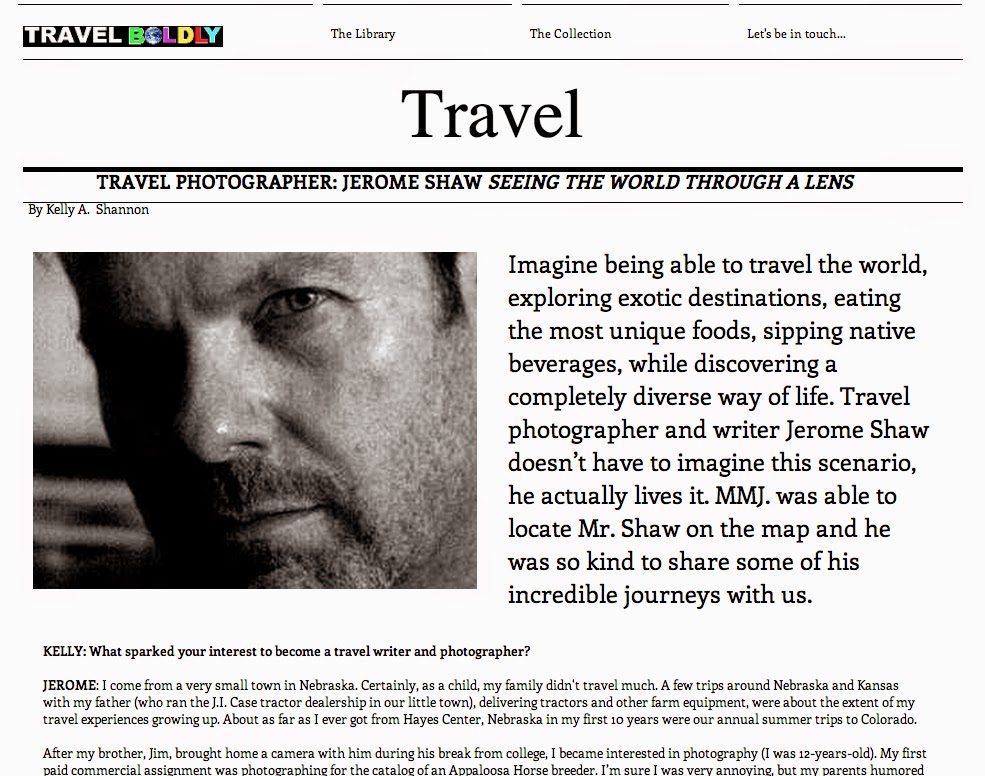
Interview with Travel Photographer Jerome Shaw on Mode - Moderne Journal

Screen capture from Mode Moderne Journal interview with Travel Writer & Photographer Jerome Shaw
Pin It


TRAVEL PHOTOGRAPHER: JEROME SHAW SEEING THE WORLD THROUGH A LENS

Imagine being able to travel the world, exploring exotic destinations, eating the most unique foods, sipping native beverages, while discovering a completely diverse way of life. Travel photographer and writer Jerome Shaw doesn’t have to imagine this scenario, he actually lives it. MMJ. was able to locate Mr. Shaw on the map and he was so kind to share some of his incredible journeys with us.

KELLY: What sparked your interest to become a travel writer and photographer?

JEROME: I come from a very small town in Nebraska. Certainly, as a child, my family didn't travel much. A few trips around Nebraska and Kansas with my father (who ran the J.I. Case tractor dealership in our little town), delivering tractors and other farm equipment, were about the extent of my travel experiences growing up. About as far as I ever got from Hayes Center, Nebraska in my first 10 years were our annual summer trips to Colorado.

After my brother, Jim, brought home a camera with him during his break from college, I became interested in photography (I was 12-years-old). My first paid commercial assignment was photographing for the catalog of an Appaloosa Horse breeder. I’m sure I was very annoying, but my parents humored me. I had a darkroom before I had car.

After studying Fine Art at the University of Nebraska, I quickly learned that my plan to become a famous “art” photographer, getting a gallery and a book deal and make millions wasn’t going to play-out. I moved to Aspen, Colorado where my brother was managing The Nugget Lodge on Main Street. I’d never been to Aspen, but I was an avid skier (well, as avid as a Nebraska Cornhusker could be). I accepted the job as assistant manager at the Nugget and was seduced by Aspen.

I wasn’t much cut out for life in the hospitality industry: making beds, cooking breakfast and doing bookkeeping is not for me. I found there was niche for a photographer somewhere between the local portrait shooter and the well-known ski photographers that were based in Aspen. I clawed my way in, went commercial, and postponed my graduate studies.

It was while I was in Aspen that my brother formed a film production company. I worked on projects with my brother and fellow photographer, Roger Morgan. Pat Griffin often joined our crew and we began making TV commercials, documentary films and eventually ski and adventure travel films.

I’d have to say that it was working on a television series sponsored by Outside Magazine for the Discovery Channel entitled “Sir Edmund Hillary’s World of Adventure” that cemented my love of travel and provided me with an opportunity to travel widely for the first time.

KELLY: When traveling, how long are you usually away from home?

JEROME: I usually have a very defined trip-length planned when I travel. And, for reasons of business and personal preference, I often keep my travels relatively short. For me, 10-14 days is best for business. However, my personal travel style is to go to a single destination and stay for month or two. I like to be in one place for as long as is practical. This way I get to know people, the pace of life and local hangouts.  But unfortunately, this method takes a toll on business and personal relationships.

KELLY: Can you tell us a few of your favorite spots off the beaten path?

Screen capture from Mode Moderne Journal interview with Travel Writer & Photographer Jerome Shaw - The Cliffs of Ua Poa, Marquesas Island, South Pacific.JEROME: The Marquesas Islands in French Polynesia cast in a central role by Herman Melville in his book Typee, and it is one of my recent favorites that are off the beaten path - waaaay off the beaten path. The Marquesas Islands are 1000 miles northeast of Tahiti. The main access for this chain of islands with names like Ua Poa, Fatu Hiva and Hiva Oa is aboard the freighter Aranui 3. I took a 14-day trip onboard the Aranui a couple of years ago. It is one of the best trips I have ever been on.

KELLY: Is there a destination you would want revisit over and over?

JEROME: New Zealand is one place that I would visit over and over. I lived there for a year and did not see nearly enough of this geographically diverse and visually dense country. Also, Brazil is my current mistress, specifically Rio. If someone calls tomorrow with a trip opportunity, I’ll be on the next plane. There are so many places in Brazil that I want to experience. Russia and Ukraine are places I have visited more than once, but I haven’t been back for many years and would like to return. In the US, Alaska is a place that I could visit once a year and never tire of.

KELLY: Where have been the easiest places to write and/or photograph?

JEROME: Peru and Ukraine, because the children are beautiful and the elderly are very photogenic. Alaska, due to its immense size and the landscapes are vast and uncluttered. But Brazil, The Marquesas Islands, and Russia were some of my favorite places to photograph.

I can’t think of any particular place that is easy to write about – but places where you get totally immersed in the culture and people prove easier to write about than places you have a tepid experience with.

KELLY: The hardest?

JEROME: As far photographing people, The British Virgin Islands was the most difficult. The people there often turned away from the camera or wanted money to have their photo taken. Weather often makes a normally photogenic locale difficult. I have had that happen in many places, but the most memorable have been in the Fiji Islands and Rio de Janeiro. Days and days of rain and gloom made getting good shots of exterior locations very tricky.

Another place that proved very difficult to capture was the lighthouse in Peggy’s Cove in Nova Scotia. They rightly placed a lighthouse on this rocky outcropped. It’s foggy there often, but the best photos of the lighthouse are made when the fog lifts. It took many, many drives out to Peggy’s Cove before I finally was fortunate enough to get that quintessential photo of the lighthouse at sunset.
The most difficult places to write about are places you are indifferent to. Love or hate make for better stories than indifference.

Screen capture from Mode Moderne Journal interview with Travel Writer & Photographer Jerome Shaw - Maisa's Lips, Copacabana, Rio de Janeiro, Brazil
KELLY: What’s one of your favorite streets in the world?

JEROME: I’m going to cheat a bit here. I don’t know what the street name is and suspect that it is not even one single street that winds its way up from Rio Centro to the hills of the Santa Teresa district of Rio de Janeiro. But I love this street and the homes and shops that line it.

I recommend you take the streetcar called bondinho, or the "little tram" (tram leaves from a station at Largo da Carioca) up to Santa Teresa. Part way to the top is a stop with a great little pizza café, and near there - up some stairs - is a wonderful Book Hostel  Rua Francisco Muratori, 10 - Santa Teresa, Rio de Janeiro - RJ, 20510-180, Brazil. There are many wonderful B&Bs in Santa Teresa and some are in artist homes.

If I ever get the opportunity to live in Rio again, you’ll find me wandering the streets of Santa Teresa, whatever their names.

KELLY: I was surprised to learn you don’t spend as much time behind the camera as one would think a travel photographer would. What takes up the majority of your time?

JEROME: Marketing and getting the next job take up a lot of my time. The normal every day minutia of operating a business also devours many hours per month. I’m also a writer, so research and writing combine into one of the largest blocks of time I spend away from my cameras.

And then, there is the management of the photographs I have created. I spend as much time editing, captioning and preparing the images for publication as I do creating them. The fact that digital photography has changed the nature of travel photography won’t surprise anyone. But many people don’t realize how is has impacted the amount of hours photographers spend behind the camera. Many of the services that I once relied on a photographic lab to perform, I now can do myself on the computer. Certainly the computer consumes more of my time than it did 20 years ago.

KELLY: Where are you off to next and what do you want to accomplish in these travels?

JEROME: Next up is a trip to Nebraska to go sailing with one of my best friends. I know, ‘sailing and Nebraska’ doesn’t sound like a natural. After that, I’ll spend most of the rest of the summer in Colorado with the possible exception of a trip to Santa Fe, New Mexico. I have trips to Glenwood Springs, Boulder and Aspen on my summer itinerary.

I have a busy fall travel calendar, with the highlights being The Big Island of Hawaii, Bora Bora and the Riviera Maya in Mexico. I am also planning trips to Mesquite and Las Vegas, Nevada to cover events and Florida.

Each year I make my Travel Wish List and, amazingly, even with such far-flung, exotic destinations included, I usually manage to score an assignment or invitation to at least one a year. So far, I haven’t had a hit on any of my 2012 list, but Bora Bora will take care of that. Some of my other wishes for 2012 are Bali, Tibet, South Africa, Iceland, Italy and Argentina.

For more information visit www.jeromeshaw.com


Kelly Shannon is a native Californian & journalist who believes each of our unique lifestyles creates our very own way of life; from our preferences of art & literature to fashion & music. Deeply intrigued by the creators and innovators of trends, style, and vitality, she is also the Editor in Chief of MMJ.

After Slow Travel in Tanzania - We Went Poco y Poco in Peru. You are never too old to travel.


Giraffe on safari Tanzania East Africa.  Photo Sally McKinney for TravelBoldly.com
A giraffe gawks back at author Sally McKinney on her safari in Tanzania. During her trip to East Africa Sally discovered that even in her 9th decade there is a way to still travel and enjoy it. Photo by Sally McKinney
Pin It
Editors note: This guest post is by my long time friend and collaborator Sally McKinney. We me met in New Zealand over 25 years ago. A few years later we began to work together as a writer / photographer team on many great adventures. Having Sally share her secrets of slow travel is a great honor for me and for Travel Boldly. I maybe telling tales out of school, but for the record Sally turned 80 this last birthday and she shows no sign of slowing down.  OK, maybe just little. ~JS

New Rules for visiting Machu Picchu Peru. 

After Slow Travel in Tanzania. We Went Poco y Poco in Peru.


Guest Post by Sally McKinney


When I was younger, I traveled all over. Watched leaping dolphins from the deck of a sailing ship. Paddled a dugout canoe. Soared above volcanic lakes in an open-cockpit biplane. Danced under starry skies to throbbing tribal drums.
Zebra Serengeti East Africa. Photo Sally McKinney for TravelBoldly.com
Zebra keep a wary eye out for trouble as they graze.  The 
safari took us through the Serengeti eco-system of East Africa

Then I got older.

As my energy waned, an “If It’s Tuesday. . .” trip became too stressful. Yet, giving up travel made me depressed. All of that changed in 2011, when I was invited to East Africa. While planning this seven-week adventure, I had to re-think my needs. The solution I came up with? Slow Travel!

PLAN FOR PEOPLE TO HELP


Two people I already knew would be also be in Tanzania for volunteer work.  One of them was Walter Miya, Tour Director, Safari Arts Expeditions. The other person would be Billy. He was (and still is) a cute, older white-haired guy from my home town.

Village market Serengeti  National Park, Tanzania, Africa. Photo Sally McKinney for TravelBoldly.com
A woman walks through the village market near Serengeti
National Park, Tanzania, Africa. 
Born in Tanzania, Walter tuned into my needs really well. Since my cloudier vision made it harder to find ticket booths, taxi stands, or departure gates, Walter found someone to meet me after a ride on the ferry, bus, or plane. Walter also helped me plan a series of home stays. While staying with middle-class Tanzanians, I could recover from travel fatigue, follow active periods with rest and enjoy leisurely meals.

By living more like the Africans than like a tourist, I learned to


SPEND ONLY ON WHAT’S IMPORTANT


After I arrived in Tanzania, Walter’s large family showed me warm hospitality. In Zanzibar, Dar es Salaam, Arusha, Marangu, and Mwanza, I slept on each family’s fanciest sheets in an air-cooled guest room.  Each morning, someone rose early to boil water, then mix hot with cool so I could bathe. Between meals, my hosts offered me snacks and cold drinks.

Mother elephant & calf safari, Tanzania, Africa. Photo Sally McKinney for TravelBoldly.com
A mother elephant and her calf amble by our safari jeep.
Staying with African families—and making new friends—meant more to me than luxurious hotels. For this trip, I could not afford new clothes, so I packed the faded, knit tee shirts and khaki slacks I usually wore.  None of my hosts seemed to mind!

MORE INFORMATION HELPED REDUCE WORRIES


While staying with Joanne and Martin Miya in Mwanza, fatigue from previous travel caught up with me. Each night after dinner, I slipped off to my room, hoping to sleep. Instead, I slapped at a lone mosquito, buzzing outside the net while I lay awake, worrying. . .

Safari Arts  Expeditions Jeep Tanzania African..Photo: Alice Fagin for TravelBoldly.com
Sally, Billy, Walter and the gang from Safari Arts 
Expeditions pose for a photo.


Twenty-seven years before, after a rainy five-day trek with the Maoris in New Zealand, I’d given up camping. After hiking all day in the rainforest, I could hardly sleep on the cold, hard ground. Knowing that, I’d promised Walter and Billy I’d go camping with them next week.

“Camping is the best way to see the animals,” Walter explained. And a camping safari was all I could afford. Yet, how could I sustain my energy if I could not sleep in the tent.  And, how could I possibly help with all the camping chores? Even worse, failing to be a good camper would—quite likely—damage my friendship with Walter. . .and with Billy, too.

During one last dinner with Joanne and Martin (Walter’s father), Martin assured me that Walter’s staff would put up the tents, also buy, cook and serve all the food.  All I had to do was show up, then eat, sleep and ride around in the jeep snapping pictures. How hard could that be?

Antelope on Serengeti Tanzania East Africa. Photo Sally McKinney for TravelBoldly.com
An antelope preens while the herd is at rest on the grasslands
of the Serengeti of Tanzania, East Africa. 
What a difference to have this new information! The day I climbed onto that jeep—and saw Billy sitting across the aisle—I felt great!

RELAX AND ENJOY THE RIDE


Walter told us to rise early next day for a game drive. To help me relax and fall asleep more easily, I took a mild sleeping tablet, washed down with bottled water. Just before dawn, I awoke to chirping birds. The sky was a vacuous gray. Beyond the tents, wild African buffalo grazed on the savanna, lowing like cattle.

On that Serengeti morning, we bounced along one of Tanzania’s roughest roads. Barely awake, and craving a second coffee, I gazed out the open window. A rosy, crescent sun seemed to float behind an acacia tree. Using a monopod (that also worked as a trekking pole), I steadied my camera to shoot a gawky giraffe.

Ever-smiling cook, Elisante Hambu. Photo Sally McKinney for TravelBoldly.com
The ever-smiling cook, Elisante Hambu.
Driver Charles Msaky spotted a leopard napping on a branch, half-hidden in dappled shade. Through the windscreen, I saw elephants cross the road—single file—as if on parade.

Using impressive tracking skills, Walter and Charles took us to watch a pride of lions. I felt privileged, wondering how many people in their lives ever get to watch lions in the wild, tending their cubs. . .then go back for breakfast.

SUSTAIN GOOD HEALTH WHILE TRAVELING


The cook, Elisante Hambu, served delicious food, using many locally-grown fresh vegetables. Those healthy meals—plus copious amounts of bottled water-- helped sustain my energy. For exercise, I’d already asked Walter to take us dancing (my favorite exercise back home). Surprisingly, he took my request
seriously.

Walter Miya, Safari Arts Expeditions serving food. Photo Sally McKinney for TravelBoldly.com
Walter Miya Tour Director, Safari Arts 
Expeditions serving food on safari.
Back in Arusha, a group of us rode one night to a local club. Masaai attendants, wrapped in red-checked  blankets, waved us into the parking lot.

“Not a tourist place,” Walter assured me. “This is where middle-class Africans go.”

When I looked around, I saw that Billy and I were the only “mazungus” (white people/foreigners) in the club. Even so, many of the other guests stopped by our table to say “Karibu” (welcome in Swahilii). After I downed an icy gin and tonic, the hot drums of the African dance band enticed me onto the dance floor. Walter, who is perhaps half my age, danced like a wild man that night. Kicking his long legs askew, he rocked his lean body, whipping those “dreads.” Clearly, I could not keep up with
him. . .but it was great fun to try.

Makonde band Tanzania African.Photo: Alice Fagin for TravelBoldly.com
Makonde band lends its African rhythm to our safari. 
Photo credit Alice Fagin

FIND A TRAVEL COMPANION


Before leaving Tanzania, Billy and I dined on Indian food at the African hotel. “Where shall we go next?” Billy asked. Secretly pleased, I had no ready reply. “I’ve always wanted to see Machu Picchu,” he continued. Not quite sure whether this was an invitation—but eager to be prepared—I began reading about Peru after we got home.


ADOPT SLOW TRAVEL FOR THE NEXT TRIP


Machu Picchu Incan Ruins Peru. Photo Sally McKinney for TravelBoldly.com
Machu Picchu is a place every traveler seems to long to visit.
Even if you are in your 80s. Sally says that's not an excuse to 
miss one of the great travel destinations in the world.
By the following summer, Billy and I were ready for Peru! My biggest worry: whether or not I’d be able to climb around the ruins of Machu Picchu.

While planning that day, I applied the Slow Travel principles I’d learned in East Africa. The night before, I visualized success—then got eight good hours of sleep. Next morning, taking a later shuttle to the ruins allowed me to eat a leisurely breakfast (and tap the energy from this food.)

Our excellent, English-speaking guide worked out a suitable climb/walk/rest pace for me. My monopod was not allowed at the site, but the guide found me a bamboo hiking stick!  At the top, we enjoyed marvelous views. Sitting on a wall, I drank water and munched energy bars. While Billy hiked on to the Sun Gate, I relaxed with a “power nap” on a grassy terrace.

Caretaker's hut  Machu Picchu World Heritage site Peru. Photo Sally McKinney for TravelBoldly.com
The steps leading up to the caretaker's hut at 
Machu Picchu World Heritage site, 
Climbing down the treacherous, rubble-strewn steps was the toughest part. Much safer to go slowly, go cautiously, I decided. I used the bamboo pole for balance and, now and then, grabbed the forearm of a helpful stranger.

GRATEFUL FOR EVERY THING THAT’S STILL POSSIBLE


Wherever did I get the idea I had to “retire” from travel?

After the shuttle ride back to Aguas Calentes, we had much to celebrate! While Billy drank cerveza, I sipped a pisco sour. On the menu: papa rellena, fresh grilled  trout, Peruvian pizza, sweet flan. When the Peru Inkas began to play—hot and fast—I could have danced with joy. Poco y poco, we had conquered Machu Picchu!


~~~


Sally McKinney Masai guards Tanzania, Africa. Photo Sally McKinney for TravelBoldly.com
Sally McKinney poses for a photo on her trip to Tanzania,
East Africa with her new friends, the Masai guards. 
Sally McKinney never dreamed that at age 80 she'd be living in Bloomington, Indiana, dancing twice a week at the local pub, and learning to cook with spices and herbs. . .while trying to book a holiday cruise around the Galapagos on a 50-foot sailboat. 

Over the years her travel articles and photographs have appeared in publications across North America and around the Pacific Rim. Travel in 47 countries (so far) has given her a unique appreciation for life on this planet. 
After writing all those articles--plus six travel guidebooks--she's now working on a memoir about how travel experiences have encouraged personal growth. In occasional pieces for ExploreDance.com, HighOnAdventure.com and now TravelBoldly, she encourages travelers to value diverse cultures, sustain the natural environment and support local economies. 

Here's her advice to other travelers who've grown older. "Even if you're losing your eyesight, don't lose your adventurous spirit. Keep traveling!"


The King of the Incas. Inti Raymi / The Festival of the Sun at Sacsayhuamán in Cusco, Peru


The King of the Incas - Inti Raymi Celebration in Cusco, Peru  .Photograph byJerome Shaw / wwwJeromeShaw.com
The King of the Incas is borne on his throne as part of Inti Raymi . the Festival of the Sun celebration at Sacsayhuamán in Cusco, Peru.  Photo by Jerome Shaw 
Pin It


The King of the Incas. “Inti Raymi / The Festival of the Sun at Sacsayhuamán in Cusco, Peru”


The celebration of Inti Raymi (The Festival of the Sun) is a grand theatrical pageant set against the back drop of the ruins at Sacsayhuamán on a hill just outside of Cusco, Peru. The dramatic recreation of the original Incan festival that celebrates the return of the sun takes place on June 24th each year, a few days after the Southern Hemisphere’s winter solstice. Exactly why it takes place on the 24th rather than on the day of winter solstice is a matter of conjecture.  My opinion is that this was the date on which the ancient Incan “astronomers” could perceptibly detect the lengthening of the days thus could assure the populace that the sun had in fact consented return for another year.

In the photograph above the Ruler of the Incas is transported upon his throne by his subjects during the processional of Inti Raymi at Sacsayhuamán. People line the walls created by the incomprehensibly large stones. These walls were created by the workmen of the lower classes of Incan Empire in the 14th and 15th centuries. Each village or region was required to contribute manpower for the public works projects of the Inca Empire. This where the huge amount of manpower needed to move these massive stones, that were quarried at the river's edge and moved miles up hill to the stronghold of Sacsayhuamán, was derived. Since the empire of the Incas was comprised of several ethnic identities, each with a different language or dialect, the members of each region were organized into distinct work regimens that were assigned specific tasks. The entire project was overseen by a Incan architect with one region's work detail quarrying the stone, another providing the manpower to drag the stone up earthen ramps with huge ropes to the construction site and yet another gang of workers being entrusted with building the log structure that was used to lower the gargantuan stones into place on the wall. Yet another set of workers might well have been employed to do the final minute adjustment so that the stones fit together so perfectly that even centuries later and after dozens of earthquakes there is not room for a sheet of paper to fit in these precision stone seams.

 Photo via Wikipeda Commons
The stone walls of Sacsayhuamán are the work of many ethic groups brought together under the auspices of the Incan Empire in the 14th & 15th centuries.  The massive sones that from these walls were hauled miles uphill from the river's edge where they were quarried and fitted perfectly into place with seams so tight they have withstood centuries.  Photo via Wikimedia

The Incan name for their empire was Tawantinsuyu, or ”four parts together." In Quechua, the word Tawantin indicates a group of four things. (tawa = four) The suffix -ntin indicates a group and Suyu means region or province.  Tawantinsuyu roughly translates as "The four lands together."  At the height of its power Tawantinsuyu stretched some 2500 miles from the Southwestern tip of present-day Columbia through Ecuador and Peru down the West Coast of South America encompassing Western Bolivia and the Northern reaches of present-day Argentina and Chile. The height of the Incan empire was relatively short-lived covering only about 100-150 years.  The consolidation of small regional governments likely began in the 12th century but since the Incas had no written language it is difficult to know with precision when the Incan Empire began. But thanks to the Spanish Conquistadors ruthlessness and well-kept records it is certain when the Incan empire came to an end. Túpac Amaru, the last Incan King, was executed in 1572.
Map of the Incan Empire at its zenith before the Spanish Conquest in the 16th Century. Via Wikipedia Commons
Map of the Incan Empire at its 
zenith before the Spanish Conquest 
in the 16th Century. Via Wikimedia


Francisco Pizarro first entered the region of the Inca in 1526 and in less than 50 years he and the Spanish Conquistadors that followed him had decimated government structure that built paved roads across the empire, some up to 24 feet wide. The Inca had unified regional municipalities that spoke dozens of languages and stretched along almost the entire length of the West Coast of South America. The Inca had created monumental architecture that would be difficult to recreate today, ever with modern technology,  The political structure of the Inca gave women equal if not preferential status in the political process but this same ruling class also sacrificed hundreds of children upon the death of an Incan ruler. For all the their many accomplishments the Inca could not withstand the onslaught of disease and the treachery of a small band of Spanish Conquistadores. Their defeat was relatively swift and the incredible gold and silver wealth of the Incan Empire was larcenously and systematically transferred to the Spanish Crown with “bits and pieces” of it falling into the pockets of the conquistadors themselves.

An Incan Princess holds an offering to sun god Inti, Inti Raymi Celebration at Sacsayhuamán in Cusco, Peru  .Photograph byJerome Shaw / wwwJeromeShaw.com
An Incan Princess holds an offering to sun god
Inti, Inti Raymi Celebration at  Sacsayhuamán
in Cusco, Peru. Photograph by Jerome Shaw 
Prior to the Spanish invasion, Inti Raymi was the most important of four ceremonies celebrated in Cusco. The celebrations took place in the Haukaypata or the main plaza in the city. Inti Raymi (Festival of the Sun) was a religious ceremony of the Inca Empire in honor of the god Inti, one of the most venerated gods in Inca religion. It was in fact the celebration of the Winter Solstice - the day with the least amount of daylight of any day of the year. The last Inti Raymi with the Inca Emperor present was carried out in 1535.


The modern day recreation of the Inti Raymi Festival has been held at Sacsayhuamán since 1944  This first recreation of Inti Raymi was directed by Faustino Espinoza Navarro with indigenous people portraying the Inca and was largely based on the chronicles of Spaniard Garcilaso de la Vega.

Sacsayhuamán is not the only place to experience Inti Raymi. The festival is still celebrated in indigenous cultures throughout the Andes. The celebrations involve music, colorful costumes, notably the woven aya huma mask, and the sharing of food.


This post is part of the Travel Photo Discovery link share. Stop by and see my fellow bloggers posts.

Peru: Machu Picchu, Iquitos and the Amazon River. Unusual choices for a honeymoon?


Honeymooning at Machu Picchu, Peru. Photo: Shannon Kircher for TravelBoldly.com
Some may think honeymooning at Machu Picchu in Peru an odd choice but not if you like your romance with a touch of adventure. Photo: Shannon Kircher for TravelBoldly.com 
Pin It


Peru: Machu Picchu, Iquitos and the Amazon River. Unusual choices for a honeymoon?


Guest Post by Shannon Kircher

A llama grazes among the ruins of Machu Picchu, Peru. Photo: Shannon Kircher for TravelBoldly.com
A llama grazes peacefully among the
stone ruins of Machu Picchu, Peru. 
After experiencing Lima and Cusco as newlyweds, we were headed off for the adventure portion of our honeymoon: heading into Machu Picchu, the Sacred Valley and then jetting off to a jungle town to depart on a three-day river cruise down the Amazon. Traditional honeymoon? Not so much. An adventure of a lifetime? Definitely.

Read part one of Shannon's honeymoon adventure in Peru.

Machu Picchu + the Sacred Valley


With limited time in Peru, we took the Hiram Bingham train from Cusco to Machu Picchu which helped with altitude sickness (Machu Picchu is actually at a lower elevation than Cusco). Machu Picchu is one of the world’s most iconic sites, filled with mystery and dramatic beauty. In all honesty, part of me was a bit fearful that we’d arrive and it would be a bit anticlimactic; so built up and just like every picture I’d seen. It wasn’t. It was magical. The journey from the base town of Aguas Calientes up to Machu Picchu is breathtakingly beautiful and the park itself is an incredible experience. We had a tour guide take us through and point out the sites. While I’m not typically a tour guide person, I don’t think there’s any other way to see this place properly. There’s too much history and mysticism around Machu Picchu to see it without someone explaining the history and sacred-qualities of some of the sites. Incredible.


A burro in the Urubamba River / Sacred Valley Peru  Photo: Shannon Kircher for TravelBoldly.com
A burro walks along alone in the Urubamba  River valley, also
known as the Sacred Valley.  Peru
After our time in Machu Picchu, we headed to the Sacred Valley of the Incas, where we spent two nights in Urubamba. Perhaps the biggest surprise of our trip (we had no expectations or pre-conceived notions about the area), the Sacred Valley left us mesmerized. Where we questioned the authenticity of people in Cusco from time to time, there was no questioning anything here. While there were other tourists, they were few and far between. We spent one of our most memorable days exploring a local market in Urubamba, buying nothing but taking everything in. Our desire to experience a more authentic side of Peru was accomplished more than ever during our day in the Sacred Valley.

Iquitos and the Amazon River


Quechua woman in the market Urubamba Peru. Photo: Shannon Kircher for TravelBoldly.com
Shopping in the market in Urubamba is necessity for this
Quechua woman but a colorful photo opportunity for visitors
The Amazon River was the final piece of our honeymoon puzzle. We had experienced city life, Incan culture and Machu Picchu and were excited to experience the river. We started with a full day in Iquitos, the river town from which we were to depart on our three-day river cruise. The city was a totally different experience, home to an incredibly impoverished community.


 Shannon on the  Amazon River. Peruvian Honeymoon. Photo: Shannon Kircher for TravelBoldly.com
The author Shannon looks out across the waters of the
Amazon River during her Peruvian Honeymoon.
The majority of visitors to the town were there to explore the Amazon or to participate in an ayahuasca retreat. We were part of the former group and boarded our Aqua Expeditions ship to begin exploring the region with 19 other passengers, ages 12 - 80. Our cruise gave us the perfect taste of the Amazon.

We spent days going out on excursions in the morning and evening, taking off on skiffs with small groups to explore deeper into the river. We swam in the Amazon (I know, sounds suspect, but it’s totally okay), went piranha fishing, trekked in the jungle with local guides and did a late-night excursion to spot caimans. We bonded with the small group of other passengers on the boat, and sipped on red wine, exchanging stories with other guests while floating down the river. The cruise was bittersweet. It was an exciting new adventure that also marked the last days of our time in Peru.

Sure, we could have spent much more time in Peru but we left feeling fulfilled after our disparate adventures.  In two short weeks, we had explored a region that was unlike any other place we had visited together. And no, Peru may not be the sexiest honeymoon destination, but those memories and those experiences are hard to beat. Watching the sunrise in Machu Picchu together? Well, that doesn’t get much better.

~~~

Shannon Kircher is the founder and editor of The Wanderlust Effect. After previous stints in London and San Francisco, she now lives in the British West Indies on the island of Anguilla. You can contact her via Facebook and Twitter.

Read part one of Shannon's honeymoon adventure in Peru.

A map of our BOLD readers

Web Statistics