Quantcast
Showing posts with label Machu Picchu. Show all posts

New Rules for visiting Machu Picchu, Peru

Pin It

New Rules for visiting Machu Picchu, Peru.

We new it was coming.  

In an attempt to limited the impact of daily visitors that number over 5 times more people than every resided in mountain fortress at the height of the Incan civilization. 

The number of daily maximum visitors is being raised to 5,940 people. In establishing the new Machu Picchu visitor numbers the Peruvian government rejected UNESCO’s recommendation of 2,500. Though the new regulations for Machu Picchu will spread visitors out over entire day weather than concentrating visits in early morning hours when light is best for travel photography. The day will be broken into 2 periods 6 AM to noon and noon to 5:30 PM.  The park will be cleared at noon of the  3,267 morning visitors allowing the 2,673 afternoon adventures to take over. It is possible to buy tickets for both sessions.

The new rules will go into effect July 1, 2017 so you still have time to grab a quick flight to Peru for Inti Raymi and a visit to Machu Picchu via the trip from Cusco. If you have already purchased tickets prior to May 2nd these restrictions will not affect you. In addition to the split sessions, guides will now be mandatory and allowed to wrangle a maximum of 16 people.  You can be sure that guide rates will rise steadily from this point on.

Visiting Machu Picchu now is a far cry from when I visited the Incan citadel in June of 1984. We walked into Machu Picchu late in the afternoon via the Inca Trail and the stone ruins were mostly deserted. We had time to visit the Hotel bar before making our way down to Aguas Calientes campground along the Urubamba River.  Early the next morning well before sunrise I set off with two of the porters from tour group to climb the steep trail back to Machu Picchu the in the dark. I had drawn the short straw and missed out on the 3 seats available in a vehicle that was arranged for our film crew by Sobeck / Mountain Travel. I arrived to find the stone walls of Machu Picchu empty. It remained that way for over thirty minutes before a few early visitors began to wander among the Incan ruins. 

These days are long gone.

At least they have not yet adopted the recommendation to build a funicular to the top of Machu Picchu.

~Jerome Shaw

More post on Peru here on Travel Boldly

Eating Boldly in Lima, Peru

After Slow Travel in Tanzania - We Went Poco y Poco in Peru. You are never too old to travel. 

The King of the Incas. Inti Raymi / The Festival of the Sun at Sacsayhuamán in Cusco, Peru

Peru: Machu Picchu, Iquitos and the Amazon River. Unusual choices for a honeymoon? 

Peru: Lima, Cusco and Machu Picchu. Unusual choices for a honeymoon? 

Inca Princess - Cusco, Peru  

Trekking Andes Mountains - Urubamba River Valley, Peru 

Me and My Llama - Peru 

Happy Guy - Wedding Guest in Urubamaba, Peru  

Trekking to Machu Picchu - Peru 

Inti Raymi Fireworks Celebration - Urabamba, Peru 

After Slow Travel in Tanzania - We Went Poco y Poco in Peru. You are never too old to travel.


Giraffe on safari Tanzania East Africa.  Photo Sally McKinney for TravelBoldly.com
A giraffe gawks back at author Sally McKinney on her safari in Tanzania. During her trip to East Africa Sally discovered that even in her 9th decade there is a way to still travel and enjoy it. Photo by Sally McKinney
Pin It
Editors note: This guest post is by my long time friend and collaborator Sally McKinney. We me met in New Zealand over 25 years ago. A few years later we began to work together as a writer / photographer team on many great adventures. Having Sally share her secrets of slow travel is a great honor for me and for Travel Boldly. I maybe telling tales out of school, but for the record Sally turned 80 this last birthday and she shows no sign of slowing down.  OK, maybe just little. ~JS

New Rules for visiting Machu Picchu Peru. 

After Slow Travel in Tanzania. We Went Poco y Poco in Peru.


Guest Post by Sally McKinney


When I was younger, I traveled all over. Watched leaping dolphins from the deck of a sailing ship. Paddled a dugout canoe. Soared above volcanic lakes in an open-cockpit biplane. Danced under starry skies to throbbing tribal drums.
Zebra Serengeti East Africa. Photo Sally McKinney for TravelBoldly.com
Zebra keep a wary eye out for trouble as they graze.  The 
safari took us through the Serengeti eco-system of East Africa

Then I got older.

As my energy waned, an “If It’s Tuesday. . .” trip became too stressful. Yet, giving up travel made me depressed. All of that changed in 2011, when I was invited to East Africa. While planning this seven-week adventure, I had to re-think my needs. The solution I came up with? Slow Travel!

PLAN FOR PEOPLE TO HELP


Two people I already knew would be also be in Tanzania for volunteer work.  One of them was Walter Miya, Tour Director, Safari Arts Expeditions. The other person would be Billy. He was (and still is) a cute, older white-haired guy from my home town.

Village market Serengeti  National Park, Tanzania, Africa. Photo Sally McKinney for TravelBoldly.com
A woman walks through the village market near Serengeti
National Park, Tanzania, Africa. 
Born in Tanzania, Walter tuned into my needs really well. Since my cloudier vision made it harder to find ticket booths, taxi stands, or departure gates, Walter found someone to meet me after a ride on the ferry, bus, or plane. Walter also helped me plan a series of home stays. While staying with middle-class Tanzanians, I could recover from travel fatigue, follow active periods with rest and enjoy leisurely meals.

By living more like the Africans than like a tourist, I learned to


SPEND ONLY ON WHAT’S IMPORTANT


After I arrived in Tanzania, Walter’s large family showed me warm hospitality. In Zanzibar, Dar es Salaam, Arusha, Marangu, and Mwanza, I slept on each family’s fanciest sheets in an air-cooled guest room.  Each morning, someone rose early to boil water, then mix hot with cool so I could bathe. Between meals, my hosts offered me snacks and cold drinks.

Mother elephant & calf safari, Tanzania, Africa. Photo Sally McKinney for TravelBoldly.com
A mother elephant and her calf amble by our safari jeep.
Staying with African families—and making new friends—meant more to me than luxurious hotels. For this trip, I could not afford new clothes, so I packed the faded, knit tee shirts and khaki slacks I usually wore.  None of my hosts seemed to mind!

MORE INFORMATION HELPED REDUCE WORRIES


While staying with Joanne and Martin Miya in Mwanza, fatigue from previous travel caught up with me. Each night after dinner, I slipped off to my room, hoping to sleep. Instead, I slapped at a lone mosquito, buzzing outside the net while I lay awake, worrying. . .

Safari Arts  Expeditions Jeep Tanzania African..Photo: Alice Fagin for TravelBoldly.com
Sally, Billy, Walter and the gang from Safari Arts 
Expeditions pose for a photo.


Twenty-seven years before, after a rainy five-day trek with the Maoris in New Zealand, I’d given up camping. After hiking all day in the rainforest, I could hardly sleep on the cold, hard ground. Knowing that, I’d promised Walter and Billy I’d go camping with them next week.

“Camping is the best way to see the animals,” Walter explained. And a camping safari was all I could afford. Yet, how could I sustain my energy if I could not sleep in the tent.  And, how could I possibly help with all the camping chores? Even worse, failing to be a good camper would—quite likely—damage my friendship with Walter. . .and with Billy, too.

During one last dinner with Joanne and Martin (Walter’s father), Martin assured me that Walter’s staff would put up the tents, also buy, cook and serve all the food.  All I had to do was show up, then eat, sleep and ride around in the jeep snapping pictures. How hard could that be?

Antelope on Serengeti Tanzania East Africa. Photo Sally McKinney for TravelBoldly.com
An antelope preens while the herd is at rest on the grasslands
of the Serengeti of Tanzania, East Africa. 
What a difference to have this new information! The day I climbed onto that jeep—and saw Billy sitting across the aisle—I felt great!

RELAX AND ENJOY THE RIDE


Walter told us to rise early next day for a game drive. To help me relax and fall asleep more easily, I took a mild sleeping tablet, washed down with bottled water. Just before dawn, I awoke to chirping birds. The sky was a vacuous gray. Beyond the tents, wild African buffalo grazed on the savanna, lowing like cattle.

On that Serengeti morning, we bounced along one of Tanzania’s roughest roads. Barely awake, and craving a second coffee, I gazed out the open window. A rosy, crescent sun seemed to float behind an acacia tree. Using a monopod (that also worked as a trekking pole), I steadied my camera to shoot a gawky giraffe.

Ever-smiling cook, Elisante Hambu. Photo Sally McKinney for TravelBoldly.com
The ever-smiling cook, Elisante Hambu.
Driver Charles Msaky spotted a leopard napping on a branch, half-hidden in dappled shade. Through the windscreen, I saw elephants cross the road—single file—as if on parade.

Using impressive tracking skills, Walter and Charles took us to watch a pride of lions. I felt privileged, wondering how many people in their lives ever get to watch lions in the wild, tending their cubs. . .then go back for breakfast.

SUSTAIN GOOD HEALTH WHILE TRAVELING


The cook, Elisante Hambu, served delicious food, using many locally-grown fresh vegetables. Those healthy meals—plus copious amounts of bottled water-- helped sustain my energy. For exercise, I’d already asked Walter to take us dancing (my favorite exercise back home). Surprisingly, he took my request
seriously.

Walter Miya, Safari Arts Expeditions serving food. Photo Sally McKinney for TravelBoldly.com
Walter Miya Tour Director, Safari Arts 
Expeditions serving food on safari.
Back in Arusha, a group of us rode one night to a local club. Masaai attendants, wrapped in red-checked  blankets, waved us into the parking lot.

“Not a tourist place,” Walter assured me. “This is where middle-class Africans go.”

When I looked around, I saw that Billy and I were the only “mazungus” (white people/foreigners) in the club. Even so, many of the other guests stopped by our table to say “Karibu” (welcome in Swahilii). After I downed an icy gin and tonic, the hot drums of the African dance band enticed me onto the dance floor. Walter, who is perhaps half my age, danced like a wild man that night. Kicking his long legs askew, he rocked his lean body, whipping those “dreads.” Clearly, I could not keep up with
him. . .but it was great fun to try.

Makonde band Tanzania African.Photo: Alice Fagin for TravelBoldly.com
Makonde band lends its African rhythm to our safari. 
Photo credit Alice Fagin

FIND A TRAVEL COMPANION


Before leaving Tanzania, Billy and I dined on Indian food at the African hotel. “Where shall we go next?” Billy asked. Secretly pleased, I had no ready reply. “I’ve always wanted to see Machu Picchu,” he continued. Not quite sure whether this was an invitation—but eager to be prepared—I began reading about Peru after we got home.


ADOPT SLOW TRAVEL FOR THE NEXT TRIP


Machu Picchu Incan Ruins Peru. Photo Sally McKinney for TravelBoldly.com
Machu Picchu is a place every traveler seems to long to visit.
Even if you are in your 80s. Sally says that's not an excuse to 
miss one of the great travel destinations in the world.
By the following summer, Billy and I were ready for Peru! My biggest worry: whether or not I’d be able to climb around the ruins of Machu Picchu.

While planning that day, I applied the Slow Travel principles I’d learned in East Africa. The night before, I visualized success—then got eight good hours of sleep. Next morning, taking a later shuttle to the ruins allowed me to eat a leisurely breakfast (and tap the energy from this food.)

Our excellent, English-speaking guide worked out a suitable climb/walk/rest pace for me. My monopod was not allowed at the site, but the guide found me a bamboo hiking stick!  At the top, we enjoyed marvelous views. Sitting on a wall, I drank water and munched energy bars. While Billy hiked on to the Sun Gate, I relaxed with a “power nap” on a grassy terrace.

Caretaker's hut  Machu Picchu World Heritage site Peru. Photo Sally McKinney for TravelBoldly.com
The steps leading up to the caretaker's hut at 
Machu Picchu World Heritage site, 
Climbing down the treacherous, rubble-strewn steps was the toughest part. Much safer to go slowly, go cautiously, I decided. I used the bamboo pole for balance and, now and then, grabbed the forearm of a helpful stranger.

GRATEFUL FOR EVERY THING THAT’S STILL POSSIBLE


Wherever did I get the idea I had to “retire” from travel?

After the shuttle ride back to Aguas Calentes, we had much to celebrate! While Billy drank cerveza, I sipped a pisco sour. On the menu: papa rellena, fresh grilled  trout, Peruvian pizza, sweet flan. When the Peru Inkas began to play—hot and fast—I could have danced with joy. Poco y poco, we had conquered Machu Picchu!


~~~


Sally McKinney Masai guards Tanzania, Africa. Photo Sally McKinney for TravelBoldly.com
Sally McKinney poses for a photo on her trip to Tanzania,
East Africa with her new friends, the Masai guards. 
Sally McKinney never dreamed that at age 80 she'd be living in Bloomington, Indiana, dancing twice a week at the local pub, and learning to cook with spices and herbs. . .while trying to book a holiday cruise around the Galapagos on a 50-foot sailboat. 

Over the years her travel articles and photographs have appeared in publications across North America and around the Pacific Rim. Travel in 47 countries (so far) has given her a unique appreciation for life on this planet. 
After writing all those articles--plus six travel guidebooks--she's now working on a memoir about how travel experiences have encouraged personal growth. In occasional pieces for ExploreDance.com, HighOnAdventure.com and now TravelBoldly, she encourages travelers to value diverse cultures, sustain the natural environment and support local economies. 

Here's her advice to other travelers who've grown older. "Even if you're losing your eyesight, don't lose your adventurous spirit. Keep traveling!"


The King of the Incas. Inti Raymi / The Festival of the Sun at Sacsayhuamán in Cusco, Peru


The King of the Incas - Inti Raymi Celebration in Cusco, Peru  .Photograph byJerome Shaw / wwwJeromeShaw.com
The King of the Incas is borne on his throne as part of Inti Raymi . the Festival of the Sun celebration at Sacsayhuamán in Cusco, Peru.  Photo by Jerome Shaw 
Pin It


The King of the Incas. “Inti Raymi / The Festival of the Sun at Sacsayhuamán in Cusco, Peru”


The celebration of Inti Raymi (The Festival of the Sun) is a grand theatrical pageant set against the back drop of the ruins at Sacsayhuamán on a hill just outside of Cusco, Peru. The dramatic recreation of the original Incan festival that celebrates the return of the sun takes place on June 24th each year, a few days after the Southern Hemisphere’s winter solstice. Exactly why it takes place on the 24th rather than on the day of winter solstice is a matter of conjecture.  My opinion is that this was the date on which the ancient Incan “astronomers” could perceptibly detect the lengthening of the days thus could assure the populace that the sun had in fact consented return for another year.

In the photograph above the Ruler of the Incas is transported upon his throne by his subjects during the processional of Inti Raymi at Sacsayhuamán. People line the walls created by the incomprehensibly large stones. These walls were created by the workmen of the lower classes of Incan Empire in the 14th and 15th centuries. Each village or region was required to contribute manpower for the public works projects of the Inca Empire. This where the huge amount of manpower needed to move these massive stones, that were quarried at the river's edge and moved miles up hill to the stronghold of Sacsayhuamán, was derived. Since the empire of the Incas was comprised of several ethnic identities, each with a different language or dialect, the members of each region were organized into distinct work regimens that were assigned specific tasks. The entire project was overseen by a Incan architect with one region's work detail quarrying the stone, another providing the manpower to drag the stone up earthen ramps with huge ropes to the construction site and yet another gang of workers being entrusted with building the log structure that was used to lower the gargantuan stones into place on the wall. Yet another set of workers might well have been employed to do the final minute adjustment so that the stones fit together so perfectly that even centuries later and after dozens of earthquakes there is not room for a sheet of paper to fit in these precision stone seams.

 Photo via Wikipeda Commons
The stone walls of Sacsayhuamán are the work of many ethic groups brought together under the auspices of the Incan Empire in the 14th & 15th centuries.  The massive sones that from these walls were hauled miles uphill from the river's edge where they were quarried and fitted perfectly into place with seams so tight they have withstood centuries.  Photo via Wikimedia

The Incan name for their empire was Tawantinsuyu, or ”four parts together." In Quechua, the word Tawantin indicates a group of four things. (tawa = four) The suffix -ntin indicates a group and Suyu means region or province.  Tawantinsuyu roughly translates as "The four lands together."  At the height of its power Tawantinsuyu stretched some 2500 miles from the Southwestern tip of present-day Columbia through Ecuador and Peru down the West Coast of South America encompassing Western Bolivia and the Northern reaches of present-day Argentina and Chile. The height of the Incan empire was relatively short-lived covering only about 100-150 years.  The consolidation of small regional governments likely began in the 12th century but since the Incas had no written language it is difficult to know with precision when the Incan Empire began. But thanks to the Spanish Conquistadors ruthlessness and well-kept records it is certain when the Incan empire came to an end. Túpac Amaru, the last Incan King, was executed in 1572.
Map of the Incan Empire at its zenith before the Spanish Conquest in the 16th Century. Via Wikipedia Commons
Map of the Incan Empire at its 
zenith before the Spanish Conquest 
in the 16th Century. Via Wikimedia


Francisco Pizarro first entered the region of the Inca in 1526 and in less than 50 years he and the Spanish Conquistadors that followed him had decimated government structure that built paved roads across the empire, some up to 24 feet wide. The Inca had unified regional municipalities that spoke dozens of languages and stretched along almost the entire length of the West Coast of South America. The Inca had created monumental architecture that would be difficult to recreate today, ever with modern technology,  The political structure of the Inca gave women equal if not preferential status in the political process but this same ruling class also sacrificed hundreds of children upon the death of an Incan ruler. For all the their many accomplishments the Inca could not withstand the onslaught of disease and the treachery of a small band of Spanish Conquistadores. Their defeat was relatively swift and the incredible gold and silver wealth of the Incan Empire was larcenously and systematically transferred to the Spanish Crown with “bits and pieces” of it falling into the pockets of the conquistadors themselves.

An Incan Princess holds an offering to sun god Inti, Inti Raymi Celebration at Sacsayhuamán in Cusco, Peru  .Photograph byJerome Shaw / wwwJeromeShaw.com
An Incan Princess holds an offering to sun god
Inti, Inti Raymi Celebration at  Sacsayhuamán
in Cusco, Peru. Photograph by Jerome Shaw 
Prior to the Spanish invasion, Inti Raymi was the most important of four ceremonies celebrated in Cusco. The celebrations took place in the Haukaypata or the main plaza in the city. Inti Raymi (Festival of the Sun) was a religious ceremony of the Inca Empire in honor of the god Inti, one of the most venerated gods in Inca religion. It was in fact the celebration of the Winter Solstice - the day with the least amount of daylight of any day of the year. The last Inti Raymi with the Inca Emperor present was carried out in 1535.


The modern day recreation of the Inti Raymi Festival has been held at Sacsayhuamán since 1944  This first recreation of Inti Raymi was directed by Faustino Espinoza Navarro with indigenous people portraying the Inca and was largely based on the chronicles of Spaniard Garcilaso de la Vega.

Sacsayhuamán is not the only place to experience Inti Raymi. The festival is still celebrated in indigenous cultures throughout the Andes. The celebrations involve music, colorful costumes, notably the woven aya huma mask, and the sharing of food.


This post is part of the Travel Photo Discovery link share. Stop by and see my fellow bloggers posts.

Peru: Machu Picchu, Iquitos and the Amazon River. Unusual choices for a honeymoon?


Honeymooning at Machu Picchu, Peru. Photo: Shannon Kircher for TravelBoldly.com
Some may think honeymooning at Machu Picchu in Peru an odd choice but not if you like your romance with a touch of adventure. Photo: Shannon Kircher for TravelBoldly.com 
Pin It


Peru: Machu Picchu, Iquitos and the Amazon River. Unusual choices for a honeymoon?


Guest Post by Shannon Kircher

A llama grazes among the ruins of Machu Picchu, Peru. Photo: Shannon Kircher for TravelBoldly.com
A llama grazes peacefully among the
stone ruins of Machu Picchu, Peru. 
After experiencing Lima and Cusco as newlyweds, we were headed off for the adventure portion of our honeymoon: heading into Machu Picchu, the Sacred Valley and then jetting off to a jungle town to depart on a three-day river cruise down the Amazon. Traditional honeymoon? Not so much. An adventure of a lifetime? Definitely.

Read part one of Shannon's honeymoon adventure in Peru.

Machu Picchu + the Sacred Valley


With limited time in Peru, we took the Hiram Bingham train from Cusco to Machu Picchu which helped with altitude sickness (Machu Picchu is actually at a lower elevation than Cusco). Machu Picchu is one of the world’s most iconic sites, filled with mystery and dramatic beauty. In all honesty, part of me was a bit fearful that we’d arrive and it would be a bit anticlimactic; so built up and just like every picture I’d seen. It wasn’t. It was magical. The journey from the base town of Aguas Calientes up to Machu Picchu is breathtakingly beautiful and the park itself is an incredible experience. We had a tour guide take us through and point out the sites. While I’m not typically a tour guide person, I don’t think there’s any other way to see this place properly. There’s too much history and mysticism around Machu Picchu to see it without someone explaining the history and sacred-qualities of some of the sites. Incredible.


A burro in the Urubamba River / Sacred Valley Peru  Photo: Shannon Kircher for TravelBoldly.com
A burro walks along alone in the Urubamba  River valley, also
known as the Sacred Valley.  Peru
After our time in Machu Picchu, we headed to the Sacred Valley of the Incas, where we spent two nights in Urubamba. Perhaps the biggest surprise of our trip (we had no expectations or pre-conceived notions about the area), the Sacred Valley left us mesmerized. Where we questioned the authenticity of people in Cusco from time to time, there was no questioning anything here. While there were other tourists, they were few and far between. We spent one of our most memorable days exploring a local market in Urubamba, buying nothing but taking everything in. Our desire to experience a more authentic side of Peru was accomplished more than ever during our day in the Sacred Valley.

Iquitos and the Amazon River


Quechua woman in the market Urubamba Peru. Photo: Shannon Kircher for TravelBoldly.com
Shopping in the market in Urubamba is necessity for this
Quechua woman but a colorful photo opportunity for visitors
The Amazon River was the final piece of our honeymoon puzzle. We had experienced city life, Incan culture and Machu Picchu and were excited to experience the river. We started with a full day in Iquitos, the river town from which we were to depart on our three-day river cruise. The city was a totally different experience, home to an incredibly impoverished community.


 Shannon on the  Amazon River. Peruvian Honeymoon. Photo: Shannon Kircher for TravelBoldly.com
The author Shannon looks out across the waters of the
Amazon River during her Peruvian Honeymoon.
The majority of visitors to the town were there to explore the Amazon or to participate in an ayahuasca retreat. We were part of the former group and boarded our Aqua Expeditions ship to begin exploring the region with 19 other passengers, ages 12 - 80. Our cruise gave us the perfect taste of the Amazon.

We spent days going out on excursions in the morning and evening, taking off on skiffs with small groups to explore deeper into the river. We swam in the Amazon (I know, sounds suspect, but it’s totally okay), went piranha fishing, trekked in the jungle with local guides and did a late-night excursion to spot caimans. We bonded with the small group of other passengers on the boat, and sipped on red wine, exchanging stories with other guests while floating down the river. The cruise was bittersweet. It was an exciting new adventure that also marked the last days of our time in Peru.

Sure, we could have spent much more time in Peru but we left feeling fulfilled after our disparate adventures.  In two short weeks, we had explored a region that was unlike any other place we had visited together. And no, Peru may not be the sexiest honeymoon destination, but those memories and those experiences are hard to beat. Watching the sunrise in Machu Picchu together? Well, that doesn’t get much better.

~~~

Shannon Kircher is the founder and editor of The Wanderlust Effect. After previous stints in London and San Francisco, she now lives in the British West Indies on the island of Anguilla. You can contact her via Facebook and Twitter.

Read part one of Shannon's honeymoon adventure in Peru.

Peru: Lima, Cusco and Machu Picchu. Unusual choices for a honeymoon?


Honeymooning at Machu Picchu, Peru. Photo: Shannon Kircher for TravelBoldly.com
 Is honeymooning at Machu Picchu, Peru an unusual choice?  Not according to Shannon Kircher, for her and her husband Peru was the perfect place for an adventure filled honeymoon. Photos by Shannon Kircher
Pin It

Peru: Lima, Cusco and Machu Picchu. Unusual choices for a honeymoon?


Guest Post by Shannon Kircher

When people ask where my husband and I honeymooned after our recent nuptials, the response is almost universally the same: “Peru?” This is accompanied by raised eyebrows and a general curiosity about what helped us decide on a South American adventure in lieu of a more traditional post-wedding escape.

Let me start by saying that my now-husband and I live in the Caribbean, on the beachy island of Anguilla, where we’ve built a home and tied the knot in front of friends and family. Knowing that we’d return to white sands and turquoise waters, we didn’t need to escape to another island somewhere around the world. We wanted adventure; something entirely different. We wanted an experience that we could perhaps enjoy more easily with youth on our side and a destination that neither of us had visited. My husband and I are both huge travelers with a few stints living abroad under our belts. We have an ever-growing travel bucket list that’s a mile long and sprinkled with untouched far-flung locales. Peru topped both of our lists so we planned out two weeks on what was quite possibly one of
the most incredible travel experiences ever: from the city streets of Lima to Cusco, Machu Picchu and the Amazon River, we left with a great taste of Southern Peru and a desire to keep exploring South America. Was it the sexiest honeymoon? Well, no. It was, however, a chance for us to continue to explore the world together and kick off our marriage with a sampling of what the future has in store. Here’s a taste of our experience, with spots that left us awe-inspired and locales that left us a bit underwhelmed.

Part two of Shannon's Peruvian honeymoon adventure on TravelBoldly.

Lima


Getting a taste of Lima Peru's European architecture. Photo: Shannon Kircher for TravelBoldly.com
Getting a taste of Lima's European architecture 
We kicked off our honeymoon with four nights in Lima. In hindsight that was entirely too long in the context of our trip but it gave us a chance to recoup after a week of wedding stress and entertaining. For us, Lima was a city of gastronomy, pure and simple. We spent a half-day exploring the ruins of Pachacamac on the outskirts of the city and made it a mission to explore some of the local markets, but our time in Lima was primarily spent dining and acclimating to the chilly July weather. Like many big international cities, it’s a bit congested and a bit dirty, plus Lima bore much more of a Spanish influence
than the Incan-infused Peru that can be found in places like Cusco and the Sacred Valley. We had seen the major ‘must-see’ sights in a day and spent the rest of our time in the city wandering on foot, and focusing on our consumption of ceviche and pisco sours across Lima. We dined at places like Panchita, Chez Wong, Maido, and a standout restaurant called Central where we were given a behind-the-scenes tour of their operation. We were a bit surprised – and dare I say, disappointed? – to note that Lima’s bar scene is nearly non-existent. I love cafes and bars for people watching and a chance to chat up locals. We met up with friends living in Lima who explained that the bar/pub scene that is a staple of many major international cities doesn’t really exist in Peru. Still, we didn’t leave hungry. Or thirsty.

Our mission in Lima was accomplished and we were ready to jet off to Cusco for a richer taste of Peru.

Cusco


I vividly remember looking out my window as we descended into Cusco, feeling like we had finally made it to Peru. When we pulled up to our hotel, an old converted Monastery near the Plaza de Armas, I was astounded. This was the Peru I had wanted to see; this was the South America that I wanted to experience. Incan influence was clearly existent here, though we spent some time trying to decide which elements were authentic.

Plaza de Armas in Cusco, Peru. Photo: Shannon Kircher for TravelBoldly.com
Plaza de Armas in Cusco, Peru
While altitudes in Peru get a bit more dramatic than Cusco, the city’s 12,000 foot elevation was still a bit dizzying. We opted out of taking pills for altitude sickness but were religious about sipping coca tea to help fight the effects. The sun was out, the weather was perfect and the mountainous backdrop was dramatic. After our initial moments of awe, we began exploring the city, heading down to the main markets, sipping on freshly squeezed juices and taking in the sights, sounds and scents of our surroundings. The city was alive with a je ne sais quoi that really great places have. We only had two days in Cusco and we could have easily spent much longer just breathing the place in and gaining a better sense of the history and Incan culture.

Incan fortress of Machu Picchu, Peru. Photo: Shannon Kircher for TravelBoldly.com
Watching the sun rise over the Citadel in Machu Picchu, the 
Lost City of the Incas. It was built around 1450 and is one of 
the New Seven Wonders of the World. Entry is limited to 2500 
visitors per day to reduce impact on the historic site.
My husband decided to test out the ‘in sickness and in health’ thing pretty quickly, and ended up
experiencing intense altitude sickness on day two (the verdict is still out on whether or not the pisco tasting the night before played a hand in that). After a hearty dose of oxygen, lots of water and a great deal of rest, he was almost 100% by the time we arrived at our next destination, Machu Picchu. A bit of advice for anyone that’s sensitive to altitude: try the soroche tablets to keep your head on straight and enjoy your time in the city. As we discovered, the onset isn’t generally immediate.

From Cusco, we continued onto Machu Picchu, where altitude sickness dissipated and we continued our newlywed adventures in Peru. Stay tuned to read about our awe-inspiring time in the Sacred Valley of the Incas and excursions on the Amazon River.


Shannon Kircher is the founder and editor of The Traveling Scholar. After previous stints in London and San Francisco, she now lives in the British West Indies on the island of Anguilla. You can contact her via Facebook and Twitter.

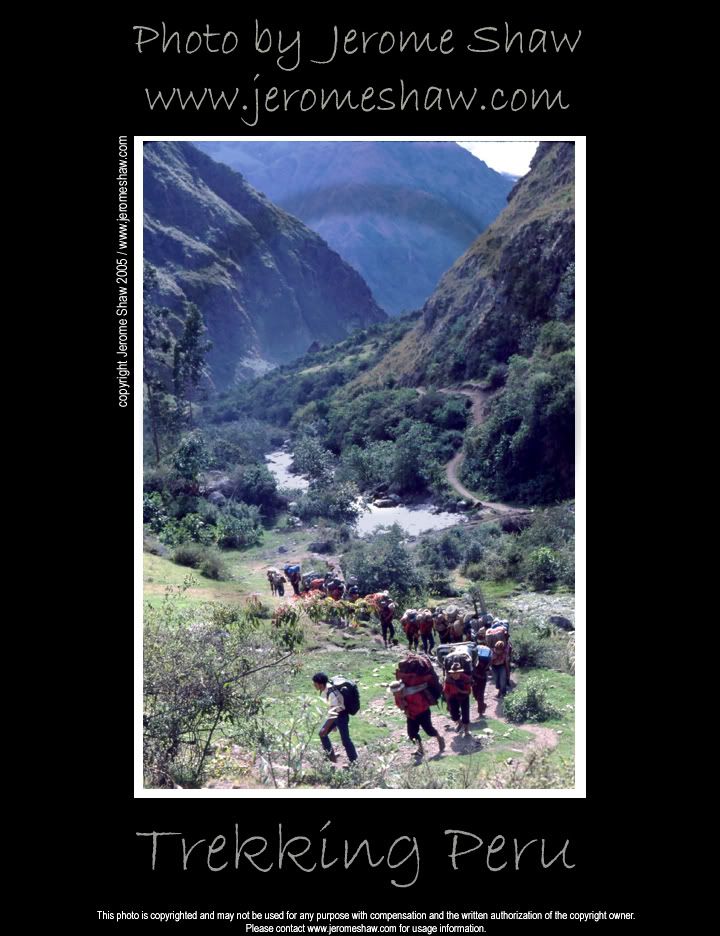
"Trekking Andes Mountains" Urubamba River Valley, Peru


"Trekking Andes Mountains" Urubamba River Valley, Peru


The porters and trekkers wind their way up the trail as we climb out of the Urabumaba River valley and begin our trek to the once Lost Incan enclave of Machu Picchu. We will be on the trail for the next three days to reach our destination. We will cross 15,000 foot passes here in the Andes on our journey.

These images are copyrighted and may not be used, re-posted or reproduced without direct written permission.

Contact me at @JeromeShaw  or Facebook 

copyright Jerome Shaw 1984 / www.jeromeshaw.com

>>>

"Trekking to Machu Picchu" Peru


Machu Picchu, Peru
Machu Picchu, Peru


New Rules for visiting Machu Picchu Peru


The Hidden City of the Inca high in the Andes Mountains is one of the great travel destinations on the planet.  After rafting for 3 days on the Urubamba River we began hiking to Machu Picchu. In 4 days of trekking we arrived to see this mysterious mountain enclave that the Inca managed to keep hidden from the Spanish. Rediscovered by Hiram Bingham in 1911, it is one of the most mystical places on earth.

Machu Picchu is on just about everyone's travel bucket list. I had the good fortune to see it early in my travel career while working on a film for Sobeck/Mountain Travel that eventually became an episode in the Discovery Channel series, Sir Edmund Hillary's World of Adventure.

My first glimpse of the iconic terraces that sit 7,970 feet (2,430 meters) above sea level on the eastern slope of the Andes came from high above in the late afternoon, after a day of trekking.  We arrived late enough that most of the tourists had departed on the last buses back to Aguas Calientes on the valley floor. Only a few a people that were fortunate enough to have rooms at the hotel just outside Machu Picchu's grounds were still wandering among the stone walls. Most of the hotel guests had already headed for the bar and were sipping cocktails and telling traveler's tales.

I'll always treasure those haunting moments as we made our way among the stone houses that housed perhaps as few as 750 people.  Now each day brings 2000+ tourists to these verdant terraces and more would come if restrictions weren't in place.  By the time the we entered the Machu Picchu it was eerily --- wonderfully empty.

These images are copyrighted and may not be used, re-posted or reproduced without direct written permission.


Contact me at @JeromeShaw  or  Facebook 


Fotolog- Postcards from Brazil / Jerome Shaw
Fotolog- Travels Along the Timeline/ Jerome Shaw
www.jeromeshaw.com


Subject : The Lost City of the Incas - Machu Picchu - Peru
Origianlly Posted to MySpace 
Post Date: : Oct 25, 2006 10:16 AM 

A map of our BOLD readers

Web Statistics