Quantcast
Showing posts with label Photo Tips. Show all posts

Defying the Sand Thieves or How Not to Get Robbed Photographing on Copacabana Beach, Rio de Janeiro, Brazil

A composite of images of Maisa Soares Silva modeling on Copacabana & Ipanema Beach  in Rio de Janeiro, Brazil. Photo: copyright Jerome Shaw / http://www.JeromeShaw.com
A composite of images of Maisa Soares Silva modeling on Copacabana & Ipanema Beach
 in Rio de Janeiro, Brazil. Photo: copyright Jerome Shaw / http://www.JeromeShaw.com
Pin It

A photo composite of some of my favorite images of Maisa on the beaches of Copacabana and Ipanema. She is a very natural model as well as a lovely person. The background image is of the sunrise in a grove of palm trees just off the boardwalk in the center of Copacabana Beach.

But for the personal relationship we made with one of the beach chair and umbrella vendors this photo shoot might not have turned out so well.  As I was making these photographs early one morning I heard Gustavo calling out to me from yards down the beach – he was excitedly waving his arms and gesturing.  I thought it a bit odd that he was so friendly at that time of the morning. He surely knew we were not in the market for beach chairs and beer.  I put down to him being friendly and went on photographing.

Maisa Soares Silva on Ipanema Beach in Rio de Janeiro,  Brazil. Photo: copyright Jerome Shaw / http://www.JeromeShaw.com
Maisa Soares Silva on Ipanema Beach in Rio de Janeiro,
 Brazil. Photo: copyright Jerome Shaw / http://www.JeromeShaw.com
It was not until some time later when we were in the market for beach chairs that the full scope of the event became apparent to me. Gustavo had spied a group of well known (well known at least to him) “sand thieves” that work Copacabana beach robbing tourists of their possessions. He called out to us not so much to wish us a good morning as to alert the “sand thieves” that we were one of his friends/customers and that he was watching and watching out for us. Unbeknownst to us we were under his protective custody while we were on ‘his’ beach.

All I can say is – it pays to make friends when you are traveling.  I make it a priority to find a coffee shop, a bar, a restaurant, and in this case a beach chair guy when I get to new destination.  For the most part I just like developing a familiar place in the midst of so many unfamiliar surroundings.  It is nice to see a smile of recognition when you walk into the bakery each morning to buy your coconut bread or in the corner shop when the clerk helps you with the word for pasts (massa) because he remembered that the last time you were in you couldn’t remember it either.

In this case developing a go to guy on the beach helped me keep my camera equipment.


These photos was taken with Nikon F100 & FG film cameras using Nikkor lenses from 20mm to 400mm. The film used for this image is Fujicolor Superia 200, the exposures vary. The photos were taken in early morning light.

Travel Writing & Photography Workshop and Tour in Santa Fe, NM


Pin It


December 11th-14th,  2014

Travel Writing & Photography Workshop and Tour in Santa Fe, New Mexico 

Registration for the Christmas time Santa Fe workshop is open.  You can see the information on the workshop below. 

Please email TravelBoldly@Gmail.com with questions,

We will be also announcing dates for Spring 2015 Santa Fe workshop and location and dates for Summer 2015 Colorado workshop.

If you'd like information on either of these workshops please send an email with "Spring Santa Fe Travel Writing Workshop" or "Colorado Travel Writing Workshop" in the subject line to Travel Boldly@Gmail.com 

Thanks,

Jerome / July 2014


Sign Up Here

Workshop Information:

Janna Graber the editor of GoWorldTravel.com and TravelBoldly's own Jerome Shaw are teaching a joint workshop in Santa Fe, New Mexico in December of 2014.  Santa Fe is great backdrop to learn more about travel journalism from these two travel experts.

New Mexico’s Native American and Spanish roots run deep. Explore this rich heritage in Santa Fe, New Mexico during our four-day tour and writing & photography workshop.

The workshop will be held at La Fonda on the Plaza in Santa Fe from December 11-14, 2014. It will offer expert instruction on travel writing techniques,  travel photography, publishing your own blog or website and the business of travel writing. It will also provide an enjoyable and in-depth look at this unique destination.

About Santa Fe

Santa Fe, New Mexico is like no other place in the United States. The region was home to Native Americans from 1200 to the early 1400′s, and then fell under six different governments over the next 400 years.

All these influences and cultures have blended together to become what locals affectionately call “The City Different.” New Mexico’s capital city is famous for her unique art, architecture and savory cuisine, and is home to 68,000 residents. With an elevation of 7,000 feet above sea level, Santa Fe is located at the base of the southern Rocky Mountains in north-central New Mexico.

During our workshop, we’ll spend time with many local experts, including artists, chefs and local businessmen, who will share their love and knowledge of Santa Fe.

Lodging

La Fonda on the Plaza, a historic inn located in the heart of downtown Santa Fe, will provide comfortable accommodations at a discounted rate for workshop participants. La Fonda can trace its roots back nearly 200 years. It offers the highest contemporary standards of hospitality along with Old World Santa Fe charm. You are free to use any accommodation in the surrounding area and attend the sessions at La Fonda.

Dining

Daily breakfast are provided via your accommodation at La Fonda, A welcome dinner is included as part of the workshop. Other meals may be purchased at your discretion. We encourage you to go out and sample some of Santa Fe’s excellent cuisine and will happily provide recommendations.

Activities

Our schedule will include guided visits to top local attractions, markets, art galleries and even a cooking class. We will visit a local Native American Pueblo. See the schedule for full details.

Price Details

Price is $699 for the workshop  +++  SAVE $100 for earlybird signup through September 15, 2014

 Sign Up Here

Price includes:

Dinner on Friday
Guided visits to local sites
City Museum Pass
All activities are within walking distance in downtown Santa Fe.
Travel writing and photography workshop sessions at the La Fonda Hotel (see schedule)


Price does not include:

Hotel (a discount code for accommodation at Santa Fe's historic La Fonda hotel is provided with registration - the special discount rate of $99/night for workshop participants includes a sumptuous breakfast) 
Meals (except as noted)
Transportation to Santa Fe
Transportation to and from hotel
Alcohol (guest may purchase at own discretion)

Details

Deposit:  Workshop space is limited. In order to reserve your spot, a $200 non-refundable deposit is due upon booking.

Balance Due: The remaining balance must be paid 35 days before your workshop begins. If the remaining balance is more than five days late, we reserve the right to sell your spot. Deposit cannot be returned.

Cancellation Policy: Because we must purchase lodging and activities so far in advance, the $200 deposit is non-refundable. If you must cancel your registration for any reason, your deposit can be applied as a credit towards any of our other Travel Writing On Location workshops.

Payment Methods:


Paypal/Credit Card     Sign Up Here


Sunday Travel Blog Roundup

Portrait of a young woman - San Angel Market, Mexico City

Portrait of a young woman - San Angel Market, Mexico City copyright Jerome Shaw 2007 / www.JeromeShaw.com
A young woman mans a fruit stand in the market of San Angel. At one time it was a small town outside
of Mexico City, San Angel has now been absorbed by the staggering sprawl of the capital city Mexico.


 Portrait of a young woman - San Angel Market, Mexico City

The market in San Angel, though indoors, has a good quality of light for photography and an excellent variety goods for purchase. It has everything from windows of fish packed in ice to hanging rows of freshly butchered chickens. There dozens of kinds fruit and vegetables.  There are peanuts, piƱatas and pumpkins, fabric and flowers, shrimp and spices, and coconuts, crabs and cactus inside the two block market. There are many places to grab a bite to eat.  It is a lively place to spend time and a great place to make photographs.  

I had to coax a smile out of this young woman at the San Angel market.  I mimed that I wanted to take a photo of her but at first she did not respond.  I looked into the camera to set up my shot and expected her expression to indicate whether I had her permission, but she was deadpan. I took one shot of her with a flat, stolid expression. I peeked around the camera and smiled at her. She smiled back and after one more exposure I knew I had my shot.  

I had lined up the composition to include the stack of oranges at the front of the stand to contrast with a background of bright yellow bananas. Light from an exterior doorway was coming from behind me.  I was shooting with a 180mm f 2.8 lens so I knew the minimal depth of field would isolate my subject. All I needed was a smile, a moment, to create a photograph.

Do you like to photograph people or would you rather photograph subjects that don't talk back?  How do you handle photographing people in public environments?  Do you ask before you shoot or beg forgiveness if the subject objects? Share you methods in the comments below.


Contact me at @JeromeShaw  or Facebook 

copyright Jerome Shaw 2007 / www.jeromeshaw.com


“Sharpness is a bourgeois concept.” – Henri Cartier-Bresson - Machedo Plaza Balcony - Mazatlan

“Sharpness is a bourgeois concept.” – Henri Cartier-Bresson - Machedo Plaza Balcony - Mazatlan  copyright Jerome Shaw 2013 / www.JeromeShaw.com
The shadows from the palm trees in Machado Plaza sway on the textured wall of the balcony above
Pedro y Lola Restaurant during the reverie of Carnival in Mazatlan, Mexico.


 “Sharpness is a bourgeois concept.” – Henri Cartier-Bresson


This is one of the first photos that caught my eye when I looked through my photos after a trip to Mazatlan, Mexico for Carnival earlier this year.  I liked the tonality of the image and the composition.
I felt it conveyed a sense of what the Machedo Plaza looked and felt like during my time there.

The photo was shot hand-held at night. It is not tack sharp but in this case I felt the slight softness created by the "too-long-for hand-held" exposure time helped create a desirable quality in the photo.  It added to a painterly quality that the shadows of the moving palm trees created as I observed the scene.

I have always liked the Cartier-Bresson quote "Sharpness is bourgeois concept" and it certainly jumped into my head as I prepared this photo for publication.

Now don't get me wrong, I like a razor sharp image as much as the next guy.  I spent the better part of my career as a commercial photographer creating images full of detail and sharpness with perfectly smooth surfaces.  Yet, there has always been a part of me that loved to drag the shutter, capture movement in my subjects, blur the sharpness and create impressions rather than present precise detail.  I like to violate the sanctity of the smooth, shiny, reflective surfaces of perfectly printed photographs. When I print this photo it calls out for a textured surface to enhance the textures of the wall and the shadows.
“It is an illusion that photos are made with the camera, they are made with the eye, heart & head.” – Henri Cartier-Bresson
A photo like this one is more about projecting the impression of the event than it is about documenting the experience.  I find that often, a small area of the overall scene often does a better job of expressing the feeling of being there than an over-reaching photo of the entirety of the scene.  A small detail of the overall setting can stand in stead for the whole scene and give the viewer keener sense of what being there was like.
“Great photography is about depth of feeling, not depth of field.” – Peter Adams
Do you feel that only photos that are tack sharp are worthy of publication?  Do you have images, though they are less than perfectly sharp, convey the feeling you intended to express?  Do you agree with Cartier-Bresson's sharpness quote? What about Cartier-Bresson's quote about how photos are made?  Please share your thoughts below in the comments, I'd like to know what you think?

Contact me at @JeromeShaw  or Facebook 

copyright Jerome Shaw 2013 / www.jeromeshaw.com

My travels to Mazatlan were sponsored by Mexico TourismGoMazatlan and Ogilvy Public Relations Worldwide

Palacio de Bellas Artes - Mexico City

The Beaux Arts exterior of the Palacio de Bellas Artes in Mexico City.
The building  houses an art museum, a performing arts theatre and opera house

Palacio de Bellas Artes - Mexico City


Mexico City has some of the finest and oldest architecture in North America.  Mexico City and the surrounding environs were thriving cities in the Mayan, Toltec and Aztec periods well before the Spanish Conquistadores arrived.  While Jamestown, Virginia was a foundering (1607) colony of lean-tos, Mexico City was a bustling Spanish settlement, decades old, with solid stone buildings and a Cathedral unrivaled in the Americas.

The Palacio de Bellas Artes (pictured above), is a neo-classical white marble structure that sits across from the Alameda and adjacent to Bellas Artes Metro Station in central Mexico City. It serves as an art museum and hosts performance arts. It is the premier opera house of Mexico City and known visually for the extravagant Beaux Arts exterior, which was created from imported Italian Carrara white marble. Palacio de Bellas Artes is the home of several murals. Most notably those of Diego Rivera, Rufino Tamayo, David Alfaro Siqueiros, and JosƩ Clemente Orozco.

The building of The Teatro Nacional, as it was then known, began on October 1, 1904. Designed by Italian architect Adamo Boari, it was originally scheduled to be completed by 1908. The project had several construction delays, many prompted by subsidence in Mexico City's notoriously poor soil. President Porfirio DĆ­az sited the theatre near the then financial district. It is located on the Northeast corner of the Alemeda promenade. The mass of the building is so great that it has been settling a few inches each year into the muddy earth of Mexico City.

The building was also delayed by many events among them the 1910 Mexican Revolution & Boari’s departure from Mexico in 1916, which virtually halted construction until 1932. Work resumed under the direction of Mexican architect Federico Mariscal and main building was completed in 1934. The final configuration of the square with gardens and Pegasus statues, designed by Boari, was not completed until 1994.

I had a wonderful evening wandering around the Alameda and through the streets of central Mexico City photographing.  A light shower might have dampened theater goers but it aided my exterior photo of the Palacio de Bellas Artes amplifying the reflections of the lights in the wet cobblestone pavement.

The best time to do cityscape "night" photos is at dusk, 30-60 minutes after sunset, while there is still light in the sky and after the building and city lights have come on.  This time period yields a more pleasing blue/black night sky than when you shoot cityscapes when it is full dark.  The building standout much more prominently than when you have the full black night sky.

Photography and text copyright Jerome Shaw 2007-2013 / www.jeromeshaw.com

Contact me at @JeromeShaw  or Facebook 

Jerome has also wriitten articles and columns for Confluence-Denver, Examiner, Johnny Jet, Bolder Planet, Recommend Magazine and Encompass Magazine


Interview with Travel Writer Jerome Shaw


A few months ago I was contacted by a college student, who asked if she could interview me about travel writing. Each month on Twitter and Facebook I receive questions from people wanting to break into travel writing, so I am publishing the Q&A in hopes that it will answer a few of the most common questions that those starting out in travel writing commonly ask.

Travel Writing & Photography Workshop and Tour 
Santa Fe, NM  December 11th - 14th, 2014

Interview with Travel Writer Jerome Shaw


How did you start off your career as a travel writer? 

Oddly, I began my career in travel writing as a photographer.  I worked as the photographer as part of a team with travel writers.  I often traveled with the writers and photographed the places and experiences that they would eventually write about.  As budgets became more restricted many publications began sending only one person on the assignments and it wasn’t the photographer. Having worked with writers on travel stories over the years I saw how they worked on location and then read their finished articles.  This insider look at their processes gave me excellent training in travel writing. I began to both photograph and write on many assignments. 

Why did you decide to pursue travel writing?

I enjoyed traveling and found the creative process involved in writing very satisfying.  To some degree it was an economic decision to combine travel writing with travel photography because of changes in the publishing industry. 

What obstacles did you face breaking into the industry?

I met with some resistance having been a photographer for so many years. Some publications refused to accept me as a writer.  Travel writing is a very competitive field, especially for the well paid assignments for high circulation publications.  The move from print to electronic media has changed the landscape of travel writing greatly.  It is now easier than ever to be published but more difficult than ever to get paid well for being published.  If this trend continues the best talent young will naturally migrate away from the industry.

What’s the best way to establish yourself if you’re starting off freelancing?

Create an excellent product, on time.  You will likely have to finance your own travel in the beginning or concentrate on local destinations.  You may also have to also accept low or no pay but I recommend you do as little of this as possible.  And never with the expectation that once you get your foot in the door with a publication by writing for free, that they will eventually hire you as a paid writer. This rarely happens.  Once you establish that you work for free or low rates it is very difficult to break out of that mold as far as an individual publication is concerned.  You’ll always be their low-cost option and the better paying assignments will go to writers that established early that they expected to be paid. Though, in the beginning you may have to allow some of your work to be published for little or no money to gain clips/samples to build your resume, chose these instances wisely.  

What advice would you give to new travel writers?

Think about the place where you live as travel destination and produce travel pieces featuring your hometown.  This is a good way to produce low cost material that won’t break the bank if you don’t get top dollar for publication.

What are common mistake travel writers make in their copy?

The mistake I make most often is to tell my readers how wonderful or terrible the travel experience was rather than show them what the experience was like.  

How did you first get published?  

As a photographer I broke in with a Aspen Magazine in Aspen, Colorado illustrating features.  My first writing publication came early in my career when I was asked by Windsurfing Magazine to write 600-800 words to accompany my photographs of boardsailing in the spring in the Rocky Mountains.  It was a laborious, time consuming process for me to write that article.  For the time spent writing I would have made much better money shooting photographs. For the next fifteen years I declined writing assignments or passed them on to my writer friends.  

My first travel article publications were for an independent small market newspaper.  They were creating a new travel section and needed a reliable source of content.  I had a backlog of content from years of traveling as photographer and had seen the necessity to do add writing to my skill set.  We were a great fit.  

Do you think it is necessary to have an agent?

No.  
While it may not be the best situation for travel
journalists the reality is most have to hone 
their skills in both writing and photography. We 
are re-entering the era of the "one man band" travel
journalist.  Soon we'll all have to add video
production to our skill set too.  

Do you think travel writers should do their own photography? Why?

Funny you should ask.  I actually do not think they should but the reality is that they must in many cases do their own photos.  Especially in the early part of their career.  I still enjoy getting an assignment to do only the photography.  It allows me to focus one thing and do it well while the writer can concentrate on getting the details right and developing a complex story.  However, many publications simply do not have the budgets necessary to support two people traveling to a location and time necessary for them to create the article as a team.  

As a fledgling travel writer, especially working for on line publications, you will certainly be asked to create or provide photography to accompany your story. Becoming passable as a photographer is the least you should do.  If you really want to put yourself in a position to be in demand you should learn basic video production skills.

Do you do any other writing besides for travel?

Yes.  I write social media and marketing copy.  I write promotional copy for brochures and website.  These are often for travel industry clients but not always.  

I write a lot of photo captions. I also write how-to photography articles.  I have in the past written for film and television projects.

What is ‘good’ travel writing?

Writing that brings the location to life and draws the reader into the story being told while providing useful information is good travel writing.  The best travel writing shows, rather than tells the reader what the travel experience was like.  Everyone thinks that they can write travel even if they can’t write a business letter or a decent short story.  The best travel writing is personal without becoming a “what I did on my summer vacation” style of writing.  Good travel writing is just good writing.

What is ‘bad’ travel writing?

Conversely, bad travel writing is just bad writing.  Two issues that are often part of bad travel writing are the use of cliched descriptions and overuse of adjectives, especially superlatives.  

What are the benefits of being a travel writer?

Travel. More specifically travel with a purpose built in.  When traveling as a journalist you get access to people and situations that the average tourist or traveler does not get.  The satisfaction of being creative is also one of the benefits of being a travel writer. For me personally, meeting new people is one of the greatest benefits of my having become a travel journalist.

What are the negative sides to being a travel writer?

Low pay and high competition are two definite drawbacks to being a travel writer. Travel writing is not a a high paying field except for a few elite writers. 

People also often equate travel with vacations. Traveling as a journalist has very little in common with vacation travel and much more in common with business travel.  It is a bit like living in resort town where most of the people visiting are there for a holiday but you have to get up and go to work while they play.  

Anything else you want to add?

If you love to travel — get rich.  If you love to write — become a traveler. ~ Jerome Shaw

Links to other interviews with Jerome Shaw: 

Mode-Moderne Journal - Travel Photographer: Jerome Shaw  Seeing The World Through a Lens  
Job Shadow - Interview with a Travel Writer/Photographer 


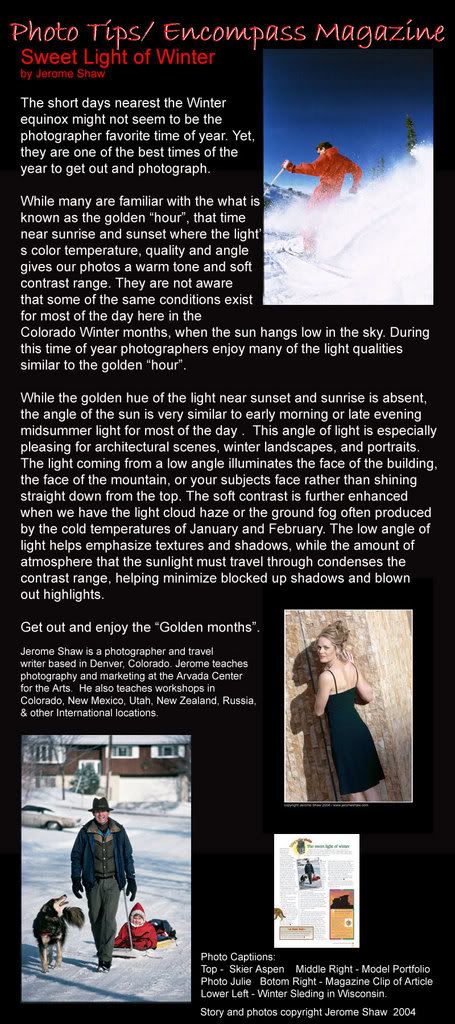
Photo Tips/ Encompass Magazine - Sweet Light of Winter


Here are some tips on why November, December and January should be your favorite months for photography - at least in the northern hemisphere.


originally published in Encompass Magazine - AAA travel publication

"Lumina" - Taos, New Mexico USA


"Lumina" 


This is one of my most favorite photos. It is quite different from many of the photos I create in that it has much more subtle tones and textures. It also has a much more complex composition.
Travel Writing & Photography Workshop and Tour 
Santa Fe, NM  May 29 – June 1, 201
I normally gravitate to cleaner more stark compositions with just a few elements. This image has many competing textures and elements. The chaos of this type of composition is often hard to manage. In my opinion for once I managed it well. The image has wonderful textural details in the shadows in the foreground. The riot of shadows created by the fence poles lead the eye around the photograph in an unrelenting manner.

The photo was created during a photo workshop I was teaching in Taos a few years back. It is very rare for me to make any decent photos while out in the field teaching a workshop. I usually do not have the time or concentration required to make good images. This is the exception. I had a rather small group and we were out early one morning near the Mabel Dodge House in Taos. The Lumina Gallery is next door and is one of my favorite places to visit in Taos. If I were rich I would live right there.

The group was complaining that they did not see much of interest to photograph. I went in search of some new subject matter for the group. I happened to take a walk to the back of the building and wedged myself, my tripod, and my camera into a very small space between the building and the fence. I could see the possibilities for the shot immediately. However, getting the camera into position on the tripod in such tight quarters proved difficult. The lighting of the scene also proved difficult to handle as well.

It is wonderful experience when the image you conceive in your head is able to be translated to the final print.

This image was featured in my shows as a 20" x 30" / 60 cm x 70 cm digital print. I have this print in my private collection.  Prints available for purchase

These images are copyrighted and may not be used, re-posted or reproduced without direct written permission. You may feel free to share this image on Pinterest.

contact me on Twitter  @JeromeShaw

© Jerome Shaw 1999  / www.JeromeShaw.com

"Yellow Composition" Tortola, British Virgin Islands


"Yellow Composition"  Tortola, British Virgin Islands.  Photo by Jerome Shaw http://www.JeromeShaw.com
"Yellow Composition"  Tortola, British Virgin Islands.  Photo by Jerome Shaw http://www.JeromeShaw.com

This photo was created on a travel assignment to the British Virgin Islands. One of the things I enjoy about being out on a travel assignment is that if gives me license to photograph things I might otherwise pass by. Wandering around during down time while out in the field is often a solitary and reflective experience. It also give me a great way to unwind and get off by myself.

While this is not one of the photos that was selected for publication with the article it is one of my favorites. I enjoy creating minimalist compositions with bold graphic elements involving rich raw color. This certainly fits that description. This wall was part of the hotel property on the island of Tortolla. What I remember most about taking this photo was having to stand high on my tiptoes to get just the composition I was looking for and to eliminate a distracting element on the edge of the frame line.

Contact me at @JeromeShaw  or  Facebook

Fotolog- Postcards from Brazil / Jerome Shaw
Fotolog- Travels Along the Timeline/ Jerome Shaw
www.jeromeshaw.com


Subject : Yellow Composition - Tortolla - British Virgin Islands
Original Posted Date: : Nov 4, 2006 9:02 AM 

>>>

A map of our BOLD readers

Web Statistics